


Most MLM systems push fast growth, big claims, and nonstop recruiting. A simple Team System is different, it aims for stable growth you can repeat without burning out or chasing friends and family.
In this post, “stable” means four consistent inputs you can control, leads, follow-up, onboarding, and retention. When those four stay steady, your team can grow without the usual boom and bust cycle, even if you only have part-time hours.
This is for beginners, part-time builders, and anyone building a Side Hustle or Home Base Business who wants to Make Money Online with a realistic routine. If you care about income security right now (with work shifting fast), start with this calm context first: a calm plan for income security at home in 2026.
You’ll also see how Automation can help you Team Build using examples like the GDI Smart Rotator and AI Viral Downline, with no hype and no guaranteed results. We’ll keep it step-by-step, including how a 7 Day Free Trial fits into a simple first-week setup.
What a “simple team system” really is (and what it is not)
A simple Team System is just a repeatable way to create steady team growth without relying on mood, luck, or nonstop pitching. Think of it like a small engine with three parts. If one part is missing, the whole thing sputters. If all three run consistently, your Team Build becomes calmer, more predictable, and easier to teach to a brand-new person.
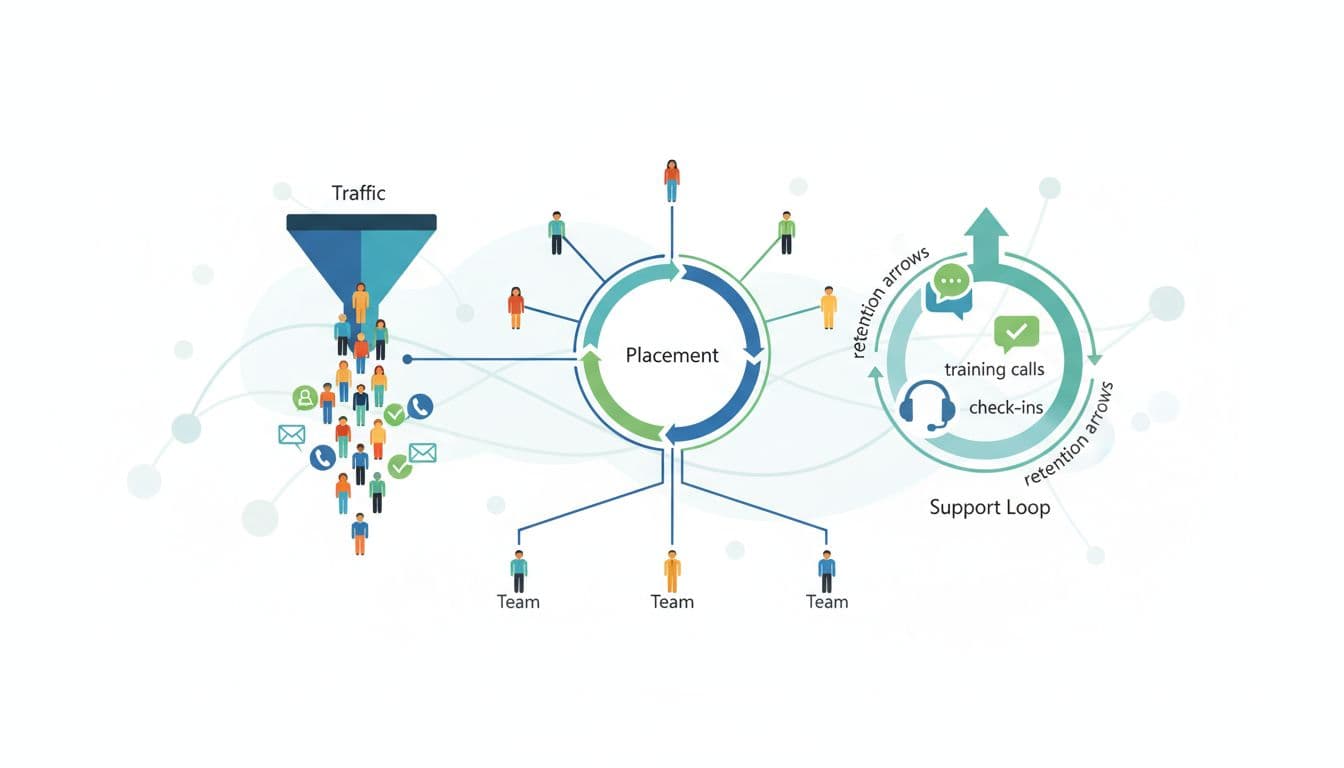
The 3 parts of a Team System: traffic, placement, and support loop
If you want stable MLM growth, you need inputs, distribution, and retention. That’s what traffic, placement, and support handle.
1) Traffic (predictable inputs)
Traffic is the simple act of bringing new people into your funnel, daily or weekly, on purpose. Beginners often think “traffic” means paid ads and advanced tools. It doesn’t. It can be:
- A short daily post that points to one clear next step
- A simple lead page and a basic follow-up message
- A low-cost traffic source that you use consistently
Stability comes from predictable inputs. Even small numbers work if they show up every week. If you want a practical example of building steady lead flow without getting fancy, use a guide like daily lead flow strategies for home businesses.
2) Placement (reduces uneven growth)
Placement is how new signups get assigned inside the team structure. In many MLMs, placement is random, emotional, or based on who “hustles” the hardest. That creates lopsided teams where a few people carry the volume and most people stall.
A smarter placement process is designed to spread growth more evenly, so momentum doesn’t depend on one superstar. This is where rotators and structured “spillover” models can help, by routing new signups into existing team positions in a defined order. The goal is not to remove effort, it’s to remove chaos.
3) Support loop (improves retention)
Support is what happens after someone joins. This is the part most teams skip, then they wonder why people quit.
A support loop is a simple rhythm, like weekly check-ins, quick start steps, short trainings, and basic follow-up accountability. It keeps people from feeling lost, and it raises the odds they stay active long enough to win.
In a stable Team Build, the loop is the glue. Traffic brings people in, placement gives them a fair spot, support helps them stick.
What this system is not: no guarantees, no magic button, no pressure recruiting
A simple system should lower stress, not create false hope. So let’s be clear about what a Team System is not.
It’s not a promise of income.
Any honest model has to say this out loud: results vary. Your outcomes depend on your effort, your consistency, your offer, and your follow-up. Systems can improve your odds, but they can’t promise a paycheck.
If someone implies “automatic income,” treat that like a warning sign. A real system talks more about actions and habits than about big numbers.
It’s not set-and-forget.
Automation can handle steps in the background (routing, tracking, follow-up), but you still show up. You still:
- Learn how to explain what you do in plain words
- Follow up with real humans
- Help new people take their first steps
A 7-day free trial can be a good way to test the setup without overcommitting, but it’s still a test of your routine too. Are you willing to do the basics for seven days in a row?
It’s not dependent on high-pressure recruiting or personal contacts.
A stable Team Build doesn’t require you to chase friends and family, guilt people, or spam your phone list. The aim is simple: create a path where strangers can become leads, leads can become conversations, and conversations can become customers or teammates.
That’s why many modern systems focus on funnels, tracking, and onboarding, instead of “cornering people” at events. If you want a deeper look at a low-cost model that emphasizes automated team placement over pressure tactics, see the step-by-step GDI Rotator overview.
Calm and consistent beats loud and pushy. Every time.
Stability principles that make the system teachable and duplicatable
You don’t build stable growth by doing more stuff. You build it by doing the right few things in a way your newest person can copy.
Here are the principles that make a Team System easier to teach, and more likely to duplicate across the team.
Consistency beats intensity.
A weekend sprint feels productive, but it usually doesn’t duplicate. A new person can copy 20 minutes a day. Most can’t copy a 6-hour grind.
Your goal is to create a baseline your team can keep even when life gets busy. That’s how stability forms.
Fewer moving parts means fewer drop-offs.
Complex systems break because beginners get overwhelmed. Keep it simple:
- One main traffic lane (for now)
- One next step (video, trial, call)
- One follow-up routine
When people join, they should know what to do in the first hour, not the first month.
Support improves retention (which protects your growth).
Retention is where stable income comes from. If people quit faster than you add them, you’re running on a treadmill.
A support loop doesn’t have to be complicated. It can be a weekly call, a pinned checklist, and a simple “Day 1, Day 3, Day 7” follow-up rhythm. What matters is that it’s dependable, and that new people know they’re not alone.
Track the right actions, not just outcomes.
Outcomes lag. Actions lead. Track what you can control, like:
- New leads added weekly
- Follow-ups done daily
- New member onboarding completed
- Training attended
This is the practical side of an MLM duplication system. The duplicatable part is not hype or personality, it’s the repeatable actions. If you want a broader discussion on duplication as a concept, this network marketing duplication principles guide offers useful perspective (even if you adapt the specifics to your style).
Where Automation fits (and where it doesn’t)
Automation is a tool, not a substitute for leadership. Used the right way, it makes your Team System steadier. Used the wrong way, it becomes an excuse to avoid the real work.

What automation can do well Automation shines in the “repeatable admin” parts of Team Build, like:
- Routing and placement workflows (so growth is distributed more fairly)
- Tracking and attribution (so you know what traffic is working)
- Reminders and follow-up sequences (so leads don’t fall through cracks)
- Onboarding steps (welcome emails, quick-start pages, checklists)
- Activity dashboards (so support is based on real behavior, not guesses)
This is why automation is so important in 2026. Many teams are choosing systems that reduce manual busywork and make growth more even across the community (including models that use rotators to create “spillover” placements for new signups).
What automation cannot do Automation cannot replace:
- Skill-building (clear messaging, simple sales skills, better content)
- Daily effort (you still need to drive traffic and follow up)
- Integrity (honest expectations, clear disclaimers, no pressure)
- Leadership (encouragement, coaching, and steady support)
A good rule: let automation handle the parts that are easy to standardize, then use your time for the parts that require judgment and care.
If you want a realistic timeline for building stability without burning out, a plan like this 90-day side hustle roadmap helps you see what “consistent” actually looks like in weekly blocks.
Why automated team placement can create stable MLM growth
A stable Team System is not about getting lucky with one big recruiter. It’s about building a structure that helps average people make steady progress, even with limited time. Automated team placement matters because it reduces the most common cause of MLM burnout: uneven growth that leaves most people waiting, guessing, and feeling like they’re behind.
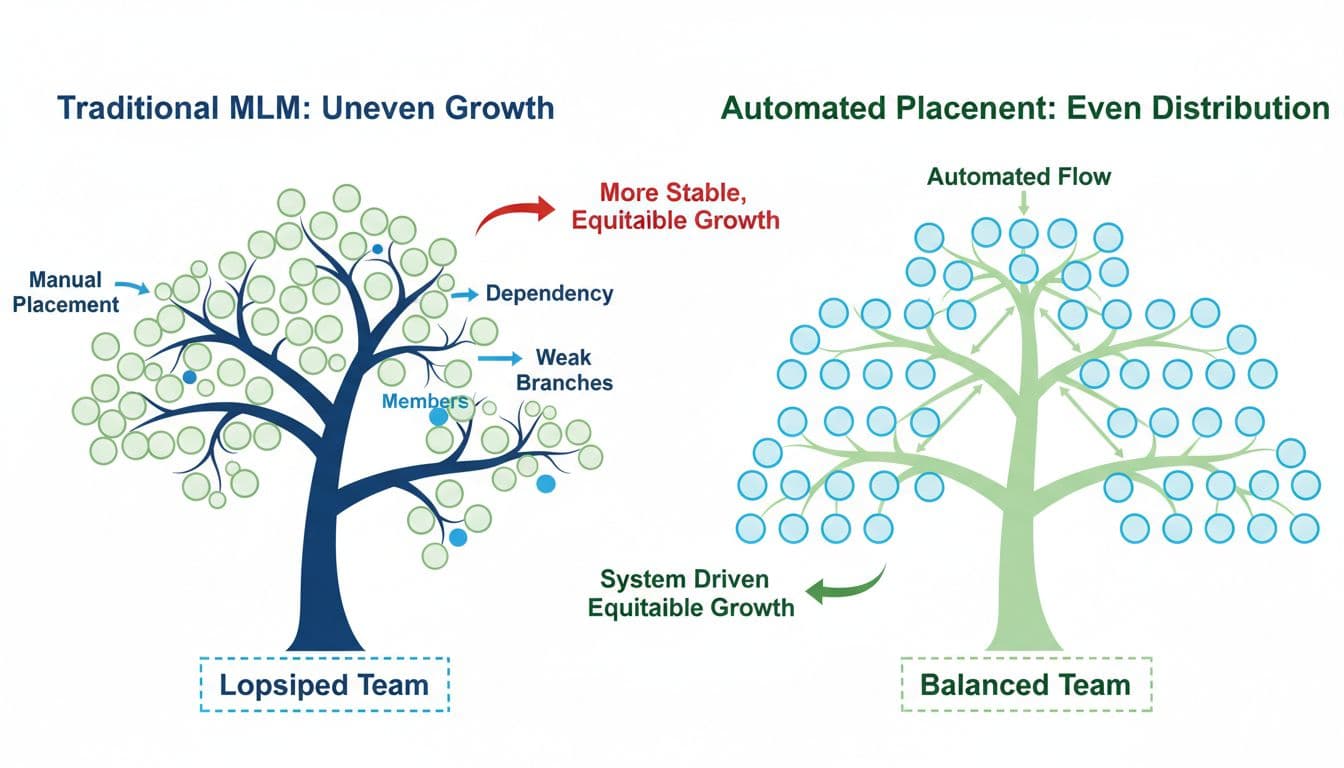
The “placement problem” in traditional MLM (and why beginners feel stuck)
Most people don’t quit because the product is bad. They quit because the experience feels random.
In a traditional MLM setup, your results can depend heavily on where you land in the team and how much sponsor support you actually get. Some sponsors are strong coaches with systems and follow-up habits. Others are busy, inconsistent, or simply not sure what to do next. That creates a big gap between the “supported few” and the “forgotten many.”
Here’s what that looks like in real life:
- You join excited, then realize there’s no clear next step beyond “make a list.”
- You try to post on social, but you don’t know what to say (so you post less).
- You see other people ranking up and assume you’re failing, even if you’re trying.
It’s not that you’re lazy. It’s that the system is asking you to do the hardest job first, selling and recruiting, before you have confidence, skills, or momentum.
Beginners feel this the most because they often have:
- No warm list they want to contact (or they already tried and it went poorly)
- Limited time blocks (kids, work shifts, side hustle hours)
- Low trust capital online (small audience, no history posting)
- No traction yet, so it feels like you’re pushing a car uphill alone
This is also where the “friends and family” pressure creeps in. When the only plan is “go recruit,” you either bother people you care about, or you do nothing, and both paths feel bad.
A Team System built around automated placement can reduce that pressure. It doesn’t remove your need to learn marketing or follow up, but it can remove the feeling that your progress depends on being the loudest person in the room.
Rotator and spillover explained in plain language
A rotator is a shared distribution method. Think of it like a line at a coffee shop, not a free-for-all. Instead of one person catching every new signup, the system rotates the next signup to the next qualified person in order.
In plain language: the traffic and placements take turns, so more people get a fair shot at building a base.
Spillover is what happens when new signups get placed under existing members because positions open or because the system is filling the next available team “spot.” It’s like pouring water into a set of cups. Once the first cup reaches a certain level, the water flows into the next cup.
Done right, spillover helps stability because it can:
- Give new people early momentum (less “starting from zero”)
- Help prevent one person from getting all the growth
- Reduce the feast-or-famine cycle that kills retention

The key point: rotator and spillover do not replace effort. They replace chaos.
A stable system still needs:
- Clear onboarding steps (so new people don’t freeze)
- Support and basic training (so people stay active)
- Transparent rules (so nobody feels tricked)
If you’ve ever watched a team fall apart because only one or two people were producing, you already understand why this matters. Automated placement spreads early wins across more members, and early wins tend to create activity. Activity creates retention. Retention creates stability.
Concrete example: how the GDI Smart Rotator model is positioned in 2026
A practical example of this approach is the GDI Smart Rotator model that’s been marketed in 2026 as an “automation-first” way to build a team structure.
At a high level, the concept is simple: new signups are routed into pre-set team positions, filling open spots under existing members. That’s the spillover effect, and it’s designed to keep the community growing without relying on manual recruiting as the only path.
What stands out about this model is how it’s positioned to help two types of people:
- Brand-new members who don’t have time, confidence, or a big list.
- Existing members who already joined GDI, but their downline is slow or unsupported.
Instead of leaving people to figure it out alone, the system is built around structured placement and (at least in the way it’s presented) ongoing community activity. Some pages also highlight live activity and stats as a transparency signal, the idea is to show that real signups and placements are happening, not just talking about them. For a quick overview of how this style of placement is presented, see the Smart Rotator’s own explanation on building a GDI team automatically.
This model also ties into why GDI is often used as the “base” program: it’s promoted as a low monthly-cost entry point (often described as $10 per month), which lowers the barrier for beginners who are testing a side hustle. GDI is also known for having a multi-level structure where commissions can be paid across multiple levels (commonly described as up to five levels), depending on the plan rules.
If you want the broader picture of how the GDI rotator concept fits into a Team System, this internal walkthrough helps: GDI Team Rotator overview.
Important reality check (keep this in your pocket): automation can place people, but it can’t force outcomes. Results vary, and any system that claims “guaranteed income” should set off alarms. Your consistency, follow-up, and ability to help a new person take their first steps still matter.
Trust builders: transparency, tracking, and ethical expectations
Automated placement can be helpful, but you should still judge it like an adult business decision. A stable Team System is built on trust, and trust comes from clarity, not hype.
When you evaluate any automated team placement model, look for these basics:
- Visibility into real activity
You don’t need flashy claims, you need proof that the system is active. A live feed, a stats page, or consistent updates can help (as long as they’re honest and not edited to look bigger than reality). - Clear placement rules
Ask: Who qualifies for placements? Is it first-come-first-served, round-robin, based on activity, or based on paid status? If you can’t understand the rules in 60 seconds, that’s not a good sign. - Tracking that matches the promise
If a system says it distributes growth “fairly,” you should see evidence of that in how referrals are assigned and how the order is managed. Tracking is also what helps prevent disputes and confusion inside the team. - Onboarding that doesn’t leave people stranded
Even the best rotator fails if new people don’t know what to do after signup. A real system has a quick start, simple training, and a support rhythm that a beginner can follow. - Honest disclaimers and ethical expectations
Any serious program should say, in plain English, that there are no guaranteed results and effort still matters. Social proof and live feeds can show activity, but they don’t promise your outcome.
If you want a broader outside view on what business automation can (and can’t) do for network marketers, this overview is a useful reference point: network marketing automation mastery guide.
The bottom line is simple: automated placement can create stability when it’s transparent, rules-based, and paired with real support. Without those, it’s just a shiny front end that breaks trust the first time someone asks, “How does this actually work?”
The Simple Team System for stable growth (step-by-step)
If you want stable growth, you need a Team System you can repeat even on busy weeks. Think of it like building a small garden. You don’t plant 12 different crops, in 12 different spots, with 12 different schedules. You pick one crop, one bed, and you water it consistently.
The steps below are designed for side hustle builders who have limited time, limited energy, and a real life that will interrupt you. Keep it simple, run it for 30 days, then improve one piece at a time.
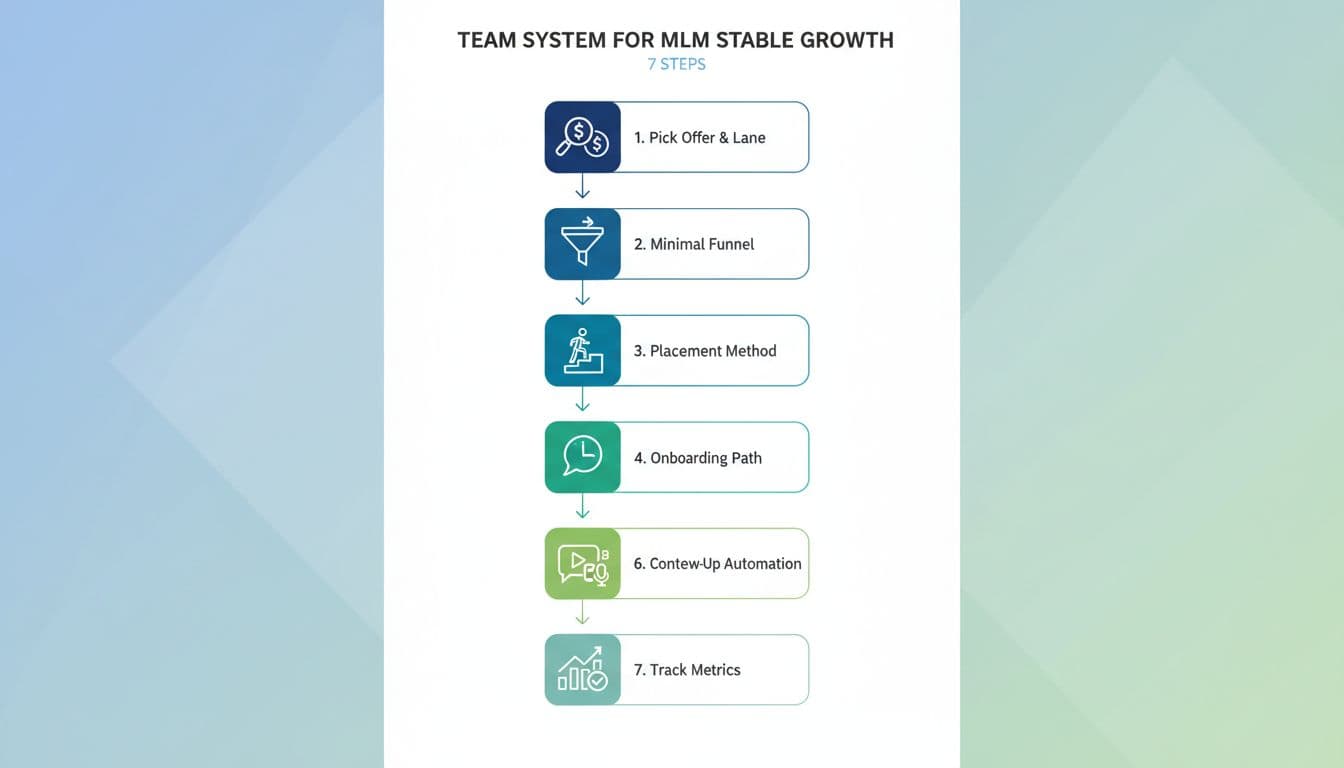
Step 1: Pick one offer and one lane (stop the overload)
Most people don’t fail because the opportunity is bad. They fail because they’re running five offers, three content styles, and two funnels, then wondering why nothing feels stable.
One primary program wins because it gives you:
- Clear messaging (your audience knows what you do)
- Cleaner tracking (you know what’s working)
- More reps (you get better faster)
- Easier duplication (your newest person can copy it)
Now pick one lane for the next 30 days. Not forever, just long enough to build momentum.
Here are a few lanes that work well for beginners:
- Content lane: short daily posts (one idea, one story, one invite).
- Short-video lane: 3 short videos per week, same structure each time.
- Community lane: one group where you answer beginner questions and point people to one next step.
- Local lane: small conversations in real life, then send people to the same simple page.
If you’ve only got 30 to 60 minutes a day, this matters. Focus protects your time and your confidence. When you want a simple mindset reset that fits a low-cost build, read why the GDI Rotator beats empty MLM promises.
Step 2: Build a minimal beginner funnel that matches real behavior
A beginner funnel should feel like a normal decision path, not a maze. Most people won’t “join now” on the first click. They want to look, think, and come back.

Your minimal assets can be just three pieces:
- Landing page: one promise, one audience, one next step.
- One next step: pick one (video, form, chat, or call). Don’t stack four options.
- Onboarding checklist page: what happens after they join (Day 1 and Week 1).
Your message should answer three questions fast:
- Who it’s for: “Busy beginners building part-time.”
- What it does: “A simple system that helps you grow steadily.”
- What happens next: “Watch this short overview, then choose your next step.”
Keep your tone clean and honest. No over-promising. If you want a simple way to turn social clicks into a focused path, use a setup like a link-in-bio funnel for network marketers. It’s the same idea, fewer choices, clearer action.
Step 3: Set your placement method (the stability engine)
Placement is where stability gets real. Without rules, team growth becomes a guessing game, and your newest people feel like they’re “behind” before they even start.
Use a simple placement template like this (you can paste this into a team doc):
- Routing rule: “New signups are placed using a defined order (example: round-robin) so growth is shared.”
- Fairness rule: “Placements only go to members who stay active and follow the basic plan.”
- After placement: “Every new member gets the same first steps within 24 hours.”
- Support delivery: “Training lives in one place, plus a weekly support touchpoint.”
The GDI Smart Rotator is one real-world example of this style of structure. It’s built around automated tracking and routing so new signups can be distributed into existing team positions, creating spillover in a rules-based way (instead of random luck). Their public pages also show live activity and stats, which helps you see ongoing movement in the community.
Important reminder: placement helps the structure, activity drives outcomes. Automation can route people, but it can’t do your follow-up, your consistency, or your leadership.
Step 4: Install a simple onboarding path to prevent early drop-off
Most drop-off happens because a new person joins, then hits silence or confusion. Your job is to remove “What do I do now?” from the first week.
You’ll write these two checklists later, but decide the path now.
First 24 hours checklist (simple and fast):
- Access login and basic setup.
- Read or watch the quick-start (10 minutes).
- Introduce yourself in the community (one short post).
- Do one small action that creates momentum (example: share your link once, or message one warm contact with permission).
First 7 days checklist (15 to 30 minutes a day):
- Learn one small skill daily (message, post, follow-up).
- Do a short outreach block (2 to 5 permission-based messages).
- Post one piece of content or comment on conversations.
- Check your metrics and update your follow-up list.
Add a support promise so people feel safe. Example: “If you ask a question in the group, you’ll get a response within 24 hours on weekdays.” Simple expectations reduce anxiety and improve retention.
Step 5: Add follow-up Automation so leads don’t go cold
Leads go cold when you rely on memory. Automation fixes that, as long as you keep it permission-based and respectful.
Start with three simple automations:
- Welcome message: deliver what you promised, and set the next step (video, overview, or call).
- Reminder sequence: 2 to 3 nudges over a week to watch the overview or finish the form.
- Simple reply prompt: one question that’s easy to answer, like “Want the beginner version or the faster version?”
Keep your language clean. Don’t pressure. Don’t imply guaranteed income.
What stays human is the part that builds trust:
- Personal check-ins after they click, watch, or reply.
- A quick voice note when someone engages.
- A real answer to a real question.
If you want your team to stick, follow-up should feel like help, not a chase.
Step 6: Add content Automation for consistent traffic without burnout (AI Viral Downline example)
Content is where most side hustle builders burn out. They post hard for a week, then disappear for a month. A better plan is consistency you can keep.
AI Viral Downline is an example of an AI-assisted approach that aims to support consistency. It’s positioned around helping with content creation and ongoing engagement so your follow-up rhythm doesn’t depend on your mood. Treat tools like this as support, not a replacement for being present and honest.
Use a simple 3-post-per-week plan:
- Proof or learning: a small lesson you learned this week, or a simple win (even a mindset win).
- Beginner education: explain one step in plain language (traffic, follow-up, onboarding).
- Invitation: one clear next step (watch the overview, start a 7-day free trial, or message you a keyword).
If you’re testing a 7-day free trial, your content job is not to “sell the dream.” It’s to guide people into a simple next step they can evaluate.
Step 7: Track the few numbers that create stability
Stable growth isn’t a spike, it’s a steady climb you can repeat. Tracking keeps you calm because you stop guessing.
Pick a weekly scorecard with just these numbers:
- New leads (added to your list)
- Follow-up touches (messages, emails, calls, DMs done with permission)
- Video or page clicks (did people take the next step?)
- Signups (new members or customers)
- Onboarding completion (did they finish the first steps?)
When one number dips, you know what to fix. If leads are steady but signups are down, your message or next step needs work. If signups are steady but onboarding completion is down, your support loop needs tightening.
This is how a Team System becomes stable. You stop reacting to feelings and start steering with simple numbers.
The weekly routine that makes this Team System sustainable
A Team System only stays stable when your actions are boring in the best way. Not exciting, not random, not based on motivation. Think of it like keeping a small fire going, you don’t throw a whole tree on it once a week, you add a few pieces every day.
This routine also protects you during a 7-day free trial window. Trials are where people either build traction, or drift. A simple rhythm keeps you moving, even if your results are still small (which is normal early on).
The 30-minute daily routine (simple and repeatable)

You don’t need more time, you need a repeatable loop. This 30-minute daily routine is built to keep leads warm, content consistent, and new members supported. Those three things are where most people lose momentum.
Here’s the exact breakdown:
10 minutes: follow-up (keep conversations alive)
This is where stability is won. Most prospects don’t decide on the first click or the first message. Your job is to be present without being pushy.
- Reply to anyone who engaged (watched, clicked, asked a question).
- Send 3 to 5 short check-ins to older leads.
- Keep it human: ask one clear question, then stop typing.
If you want proven follow-up habits that fit a realistic schedule, you’ll like Proven MLM success habits. The big idea is simple: follow-up is a kindness when it’s permission-based and respectful.
10 minutes: content and comments (stay visible without burning out)
You’re not trying to “go viral.” You’re trying to be consistently findable.
Post one of these:
- A quick lesson you learned (one paragraph).
- A simple result you got (even a small one, like finishing setup).
- A short invitation to your next step (video, trial, or message).
Then spend the rest of the 10 minutes commenting on other posts, answering questions, and being part of conversations. Comments often outperform posts for beginners because they create real back-and-forth.
10 minutes: onboarding support or learning (protect retention)
Automation can handle placement and routing, but it can’t replace support. Use this time to either:
- help one new person take their next step, or
- learn one small skill you can use today (better message, clearer post, tighter onboarding checklist).
This daily routine protects consistency. It keeps your Team System moving forward even when life gets loud.
For a practical reminder on why small routines beat occasional hustle, see Consistency for network marketers.
The 60-minute weekly reset (one change at a time)
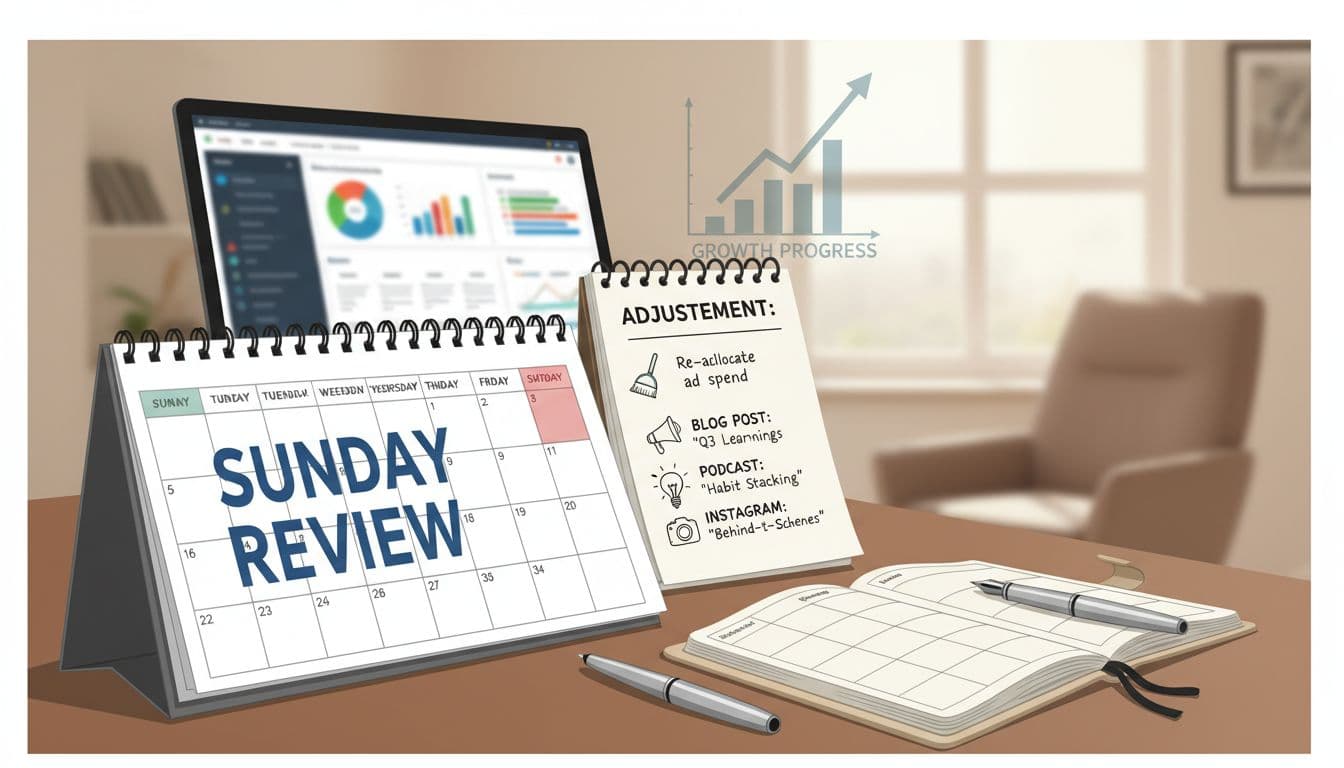
Your weekly reset is where you stop guessing. It’s also where you avoid the trap of changing everything at once. The rule is simple: review everything, change one thing.
Here’s a clean 60-minute weekly reset you can run every week (same day, same time):
Minutes 1 to 15: check the few metrics that matter
You don’t need a complicated dashboard. Track:
- leads added
- follow-ups sent
- people who watched the main video or took the next step
- signups (if any)
- new member onboarding completed
If a tool like a rotator is handling placement, that’s great, but your weekly check still matters because it keeps your activity honest. Many systems show activity feeds and stats to highlight momentum, but nothing is guaranteed. Your inputs still drive your outcomes.
Minutes 16 to 30: clean your follow-up list
This is where overwhelm disappears. Remove clutter and create a short “this week” list.
- archive dead conversations
- tag warm leads
- write the next message you will send
When your list is clean, your daily 10-minute follow-up block becomes easy.
Minutes 31 to 45: pick one adjustment only
Common “one thing” fixes:
- your opening message is too long, shorten it
- your call-to-action is unclear, simplify it
- you are posting randomly, pick one posting time
This is consistency over intensity in real life. Small course corrections beat constant reinvention.
Minutes 46 to 60: prep 3 posts (no perfection)
Write three simple posts for the week so you’re not creating from scratch every day. A good mix:
- beginner tip
- personal lesson or result
- invite to your 7-day free trial or overview
Now you start Monday calm instead of scrambling.
The one-system rule to reduce overwhelm
Most people don’t quit because the work is hard. They quit because they’re trying to run three systems at the same time. One offer, two funnels, five content styles, plus a new “strategy” every weekend.
The fix is the one-system rule:
Commit to one offer, one funnel, and one content format for 30 days before adding anything new.
That means:
- One offer: your main program, not three side programs.
- One funnel: one clear path (watch a short overview, start a trial, request info).
- One content format: pick the style you can repeat (short posts, short videos, or simple lives).
This rule improves two things your Team System depends on:
Duplication
New people copy what’s simple. When your process is stable, you can say, “Do this daily routine for 7 days,” and they can actually do it. That’s how a team grows without needing constant hand-holding.
Retention
People stay when they feel progress. Progress comes from reps. Reps come from focus. When you keep the system the same for 30 days, your team learns faster, your messaging gets sharper, and new members feel less lost.
If you’re in a 7-day free trial period, this rule matters even more. A trial is not the time to “test everything.” It’s the time to prove you can run the basics on repeat, then decide if you want to scale.
What breaks simple systems (and how to prevent it)
A simple Team System isn’t fragile because it’s “too basic.” It usually breaks because people keep adding moving parts, skipping the boring steps, or expecting the system to produce results without consistent activity. The fix is almost always the same: remove friction, tighten the first-week experience, and track a few signals so nothing slips through.
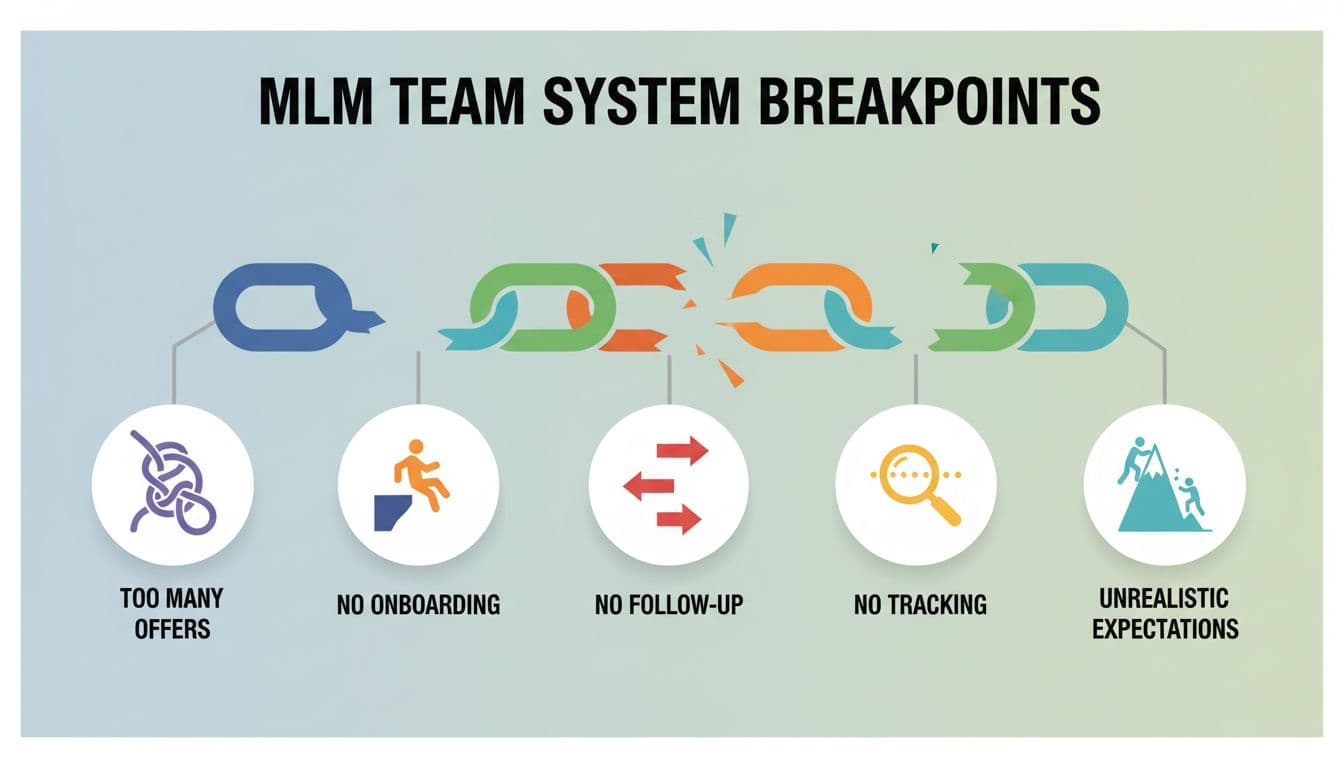
The most common breakpoints that kill stable MLM growth
Most teams don’t “fail,” they slowly leak. Here are the breakpoints that cause that leak, and why each one destroys stability.
- Too many offers: When you promote three programs, two funnels, and a new idea every weekend, people don’t know what to do first. Confusion creates hesitation, hesitation creates inaction, and inaction kills duplication. The fastest way to break a Team System is to make it impossible to explain in one sentence.
- No onboarding: If someone joins and immediately hits silence, you lose them in the first 24 to 72 hours. This is the highest drop-off window. New members don’t need “more training,” they need a clear next step and a simple win. Without onboarding, the system turns into a revolving door.
- No follow-up: Most prospects don’t decide on the first click. Without follow-up, you miss the second and third touch where decisions are often made. This is also where “automation-first” tools can help by keeping reminders consistent, but only if you still show up to reply like a real person.
- No tracking: If you don’t track anything, you end up steering by feelings. One week feels “slow,” so you change offers. Another week feels “busy,” so you stop following up. Tracking prevents panic pivots. Even basic tracking (leads, follow-ups, and onboarding completion) keeps a simple system stable.
- Unrealistic expectations: Big promises create short attention spans. When someone expects instant income, a few quiet days feels like failure. Real systems grow from reps, not hype. Programs that use automation or rotators can support activity (like handling placements or routing), but they still can’t guarantee outcomes, because effort and follow-through stay on you.
If you want to reinforce the “steady and realistic” mindset across your team, keep a simple reference like this bookmarked and shared: a calm plan for income security at home in 2026.
One simple fix for each breakpoint
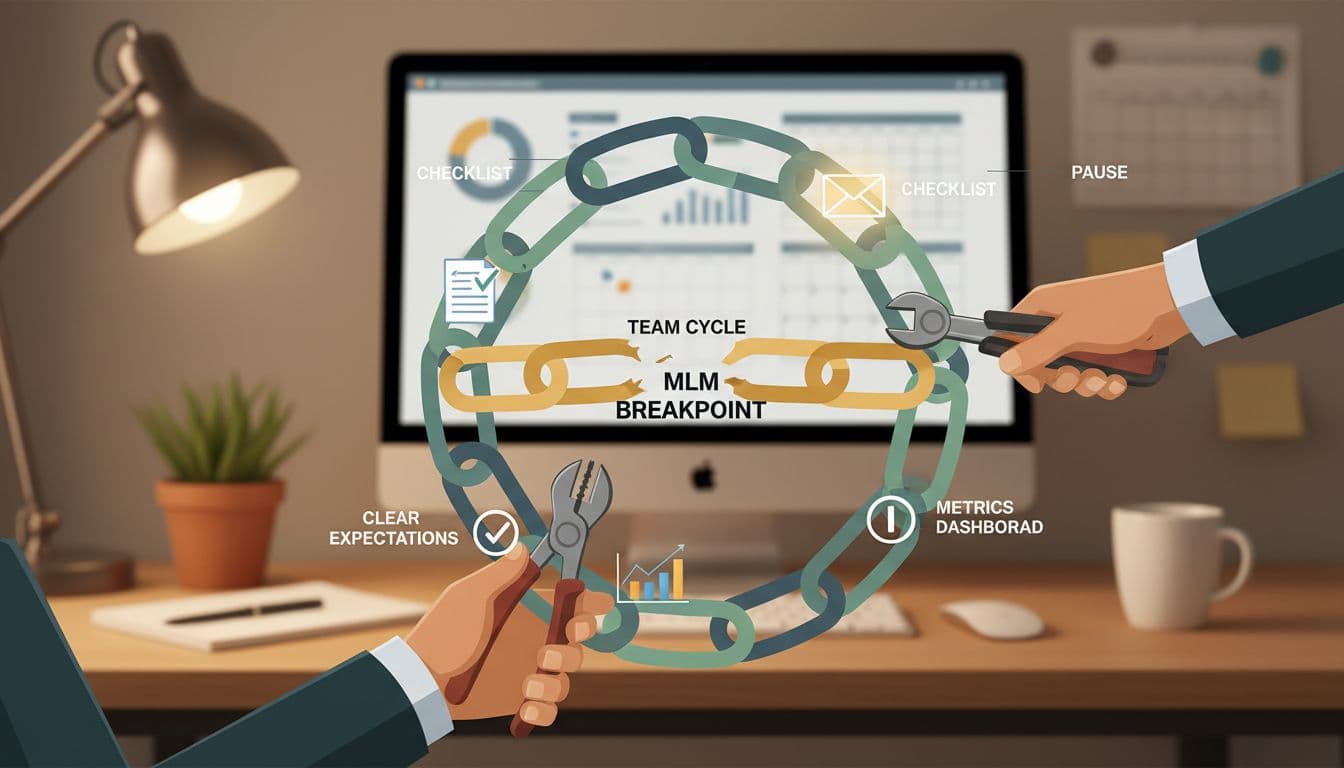
You don’t need a complex rebuild. You need five small, non-negotiable fixes that keep the system from leaking people and leads. Think of these like tightening bolts on a bike, small turns that prevent big crashes later.
Pause extra offers: Pick one main offer for the next 30 days. One funnel, one call-to-action, one message. You can add later, but right now you’re building stability. When your team can repeat the same steps, you get real duplication.
Add a one-page checklist + welcome message: Your onboarding should fit on one page. Not a course, not a giant Google Drive. A checklist plus a short welcome message that says: “Here’s what to do today, here’s where to ask questions, here’s your Day 1 win.” This matters even more during a 7-day free trial, because trials expire fast, and confusion eats the whole week.
Add a 7-day reminder sequence: Build a simple Day 1, Day 3, Day 7 reminder rhythm for prospects and new members. It can be email, SMS, or DMs, the channel matters less than consistency. The goal is to prevent missed touches. If you’re using automation tools, treat them like a calendar that never forgets, not a robot that replaces you.
Pick 3 metrics weekly: You don’t need a giant dashboard. Track three numbers every week:
- New leads added
- Follow-up touches completed
- Onboarding completion (did new people finish the first steps?)
If one dips, you know exactly what to fix next week. For context on why MLM systems fail when basics like training and team management get weak, see this breakdown of common MLM failure causes.
Restate effort, time, and learning curve clearly: Say it out loud, often: “This system supports activity, but it doesn’t replace it.” Automation can help route placements, schedule reminders, and keep things organized (some platforms even highlight things like lead counts, views, and response activity), but it can’t do your daily follow-up or teach your new person how to communicate with confidence. If you want another angle on common challenges teams run into, this overview of top MLM challenges and solutions can help you spot weak spots early.
How to explain the system without hype (copy-ready scripts)
If you want your Team System to grow without drama, your words have to match reality. Most prospects are not looking for a “perfect” pitch, they’re looking for a clear explanation they can trust. The goal is simple: explain what the system does (and what it doesn’t), point to the next step (like a 7 Day Free Trial), then let people decide without pressure.

Simple prospect explanation (bullets you can use today)
Use this when someone asks, “What is this?” Keep your tone calm, like you’re explaining a gym membership, not pitching a lottery ticket.
- What it is: “It’s a simple Team System built around two things: steady daily actions and Automation that handles the repeatable admin, like routing and tracking.”
- What ‘Team Build’ means here: “Team Build just means you’re not trying to do everything alone. The system helps organize growth so new people can be placed fairly, and everyone follows the same quick-start.”
- Who it helps: “It’s best for beginners, part-time builders, and anyone tired of chasing friends and family. It can also help existing members who feel stuck and want a cleaner plan.”
- What you do first: “You start with the basics: watch a short overview, set up your account, then follow a simple 15 to 30 minutes a day routine. If it fits, you can test it using the 7 Day Free Trial.”
- Why it stays stable (system + support): “Stability comes from rules and routine. The system handles placement and tracking consistently, and the support side gives you a clear checklist and a place to ask questions so you don’t get lost.”
If you want a clean way to describe the “low-cost, simple start” angle, you can point people to a deeper explanation like Discover GDI Rotator Team Builder, then bring the conversation back to one question: “Would you rather test something simple for 7 days, or keep guessing?”
Simple new-member explanation (today’s actions + what a ‘winning week’ is)
New members don’t need motivation, they need a map. This script gives them a “do this today” plan, plus a definition of a winning week that doesn’t require hype or hero hours.
Start with this:
“You’re not behind. Your only job this week is to follow the quick-start and stack small wins. We’re building consistency, not perfection.”
Here’s what to do today (copy-ready):
- Set up your basics: Log in, confirm your details, and bookmark the main training and support area (so you don’t hunt for links later).
- Watch the short overview: This is your “big picture” so the steps make sense. Don’t overthink it.
- Post your first simple message: One short post or message that says you’re testing a system and you’ll share what you learn (no income talk).
- Do your first follow-up block: 10 minutes, reply to anyone who engages, and send 3 friendly check-ins.
- Check in for support: Ask one question early. Fast questions prevent slow quitting.
Define a “winning week” like this:
- You show up 15 to 30 minutes a day (even on busy days).
- You complete the quick-start steps without skipping.
- You start a few real conversations (not mass spam).
- You learn one skill that makes week two easier (better message, clearer invite, cleaner follow-up list).
This is what stability looks like. A calm week of repeatable actions gives your Team System something real to build on.

Clear disclaimers to keep everything honest and compliant
If you want long-term trust, your disclaimers can’t be buried or vague. Say them early, say them clearly, and repeat them often. Transparency beats hype every time.
Use a short disclaimer like this (copy-ready):
- No guaranteed income: “There’s no guaranteed income here. Nobody can promise what you’ll earn.”
- Results vary: “People get different results based on time, consistency, skills, and follow-up.”
- Tools don’t replace effort: “Automation can handle placement, tracking, and reminders, but it doesn’t do the work for you. You still have to show up and talk to people.”
- Consistency matters: “This is built for steady action, not lucky spikes. The plan works best when you keep the 15 to 30 minutes a day routine.”
If you want a credible reference point for why earnings talk should be handled carefully, the FTC has highlighted common problems with MLM income disclosures and earnings impressions in its FTC staff report on MLM income disclosures. You don’t need to scare people with legal talk, but you do need to avoid “easy money” language.
A final line that keeps you safe and respected:
“I’d rather you understand this clearly than join on emotion. If you like what you see, test it with the 7 Day Free Trial and judge it by your actions and your experience.”
FAQs
If you’re trying to build a stable Team System without hype, you’ll probably circle the same questions every week. That’s normal. Most people aren’t stuck because they’re “bad at MLM,” they’re stuck because the rules feel fuzzy, the routine feels heavy, and the tech feels confusing.
Use these FAQs as a quick self-check. If you can answer these clearly for yourself, you can usually explain the system clearly to a prospect or a brand-new teammate too.
Team System and automation basics (questions only)
- What is a simple Team System in MLM, in one sentence, without using buzzwords?
- If my Team System was a checklist, what are the 3 to 5 steps a beginner repeats weekly?
- What part of team growth should be manual (human), and what part should be automated (system)?
- What does “team build” mean in my plan, does it mean customers, affiliates, or both?
- If I had to explain my Team System to a tired parent in 30 seconds, what would I say?
- What does “automation” actually mean in MLM, routing, tracking, follow-up, onboarding, or all of the above?
- How does automation reduce the need to recruit friends and family, without pretending effort is optional?
- What are realistic examples of “non-recruiting” behaviors that still lead to team growth (content, lead capture, follow-up, simple invites)?
- What’s the difference between not recruiting friends and family and never talking to anyone at all?
- Which tasks should automation handle so I don’t rely on memory (follow-up, reminders, tagging, onboarding steps)?
- What is spillover in plain language, and why do people misunderstand it?
- In a rotator-based Team System, how are new signups assigned, and what rules decide who qualifies to receive them?
- Is spillover something I can count on, or is it a possible benefit that depends on system activity and my own consistency?
- How does spillover help a brand-new person avoid the “starting from zero” feeling, without creating false expectations?
- What are the ethical red flags around spillover (income promises, guaranteed placements, pressure language)?
- If someone asked “Where exactly do new signups go?”, could I explain it clearly using a simple analogy (like taking turns in line)?
Tools and positioning (questions only)
- Is GDI a good home base business for beginners who want a low monthly start?
- What does “home base business” mean in this context, a product/service you can explain, plus a compensation plan, plus basic tools?
- If I’m brand-new, what’s the simplest way to describe what GDI offers (domains, basic online tools, affiliate structure)?
- What’s the realistic reason someone would pick GDI as a base, low cost and simplicity, or high earnings and fast wins?
- What are the honest downsides a beginner should know before joining any MLM-style program (learning curve, time, attrition, personal responsibility)?
- What’s my plan if someone asks, “Is this guaranteed income?”, and how do I answer without getting awkward?
- What is the GDI Smart Rotator, and what problem is it meant to solve for team builders?
- What does the rotator automate, lead distribution, placement into team “spots,” tracking, or all three?
- How does the rotator decide who receives the next signup (round-robin, activity-based, eligibility rules)?
- If I already have a GDI account but my downline is quiet, how is a rotator positioned to help me restart momentum?
- What does “advanced tracking” mean in a practical sense, what is being tracked (traffic source, signups, placements, activity)?
- Where can I see system activity (like live stats or a live feed), and what should I remember about those numbers (proof of activity, not a promise)?
- Can AI Viral Downline help with content and follow-up if I’m building a side hustle with limited hours?
- What parts of content can an AI tool support (ideas, drafts, scheduling, repurposing), and what parts still need me (truth, tone, compliance)?
- Can an AI system help with follow-up reminders so leads don’t slip through cracks, while still keeping messages permission-based?
- If a tool claims it can “close prospects for you,” what questions should I ask to stay realistic (what’s automated, what’s not, what’s required)?
- How do I use AI without turning my business into spam (fewer messages, better targeting, real conversations)?
- If I only post 3 times per week, what should those posts be (proof/lesson, beginner tip, simple invite), and how does AI help me stay consistent?
Routine, tracking, and sustainability (questions only)
- How much time per day does it usually take to make money online with a basic routine, if I’m building part-time?
- If I only have 30 minutes per day, what are the highest value actions (follow-up, one post, onboarding support)?
- If I only have 15 minutes per day, what should I do first so I don’t waste the week?
- What does a “winning week” look like if I get zero signups but I did the right inputs?
- What does a “losing week” look like even if I feel busy (random posting, no follow-up, switching offers)?
- What should I track weekly to keep growth stable, even when results are slow?
- Which numbers are inputs I control (leads added, follow-ups sent, posts published), and which are outcomes that lag (signups, commissions)?
- What is the simplest weekly scorecard I can track without a spreadsheet addiction?
- How do I track onboarding so new people don’t quietly disappear after day 2?
- If I’m using a rotator system, what should I track separately from my personal activity (placements received, contacts made, onboarding completion)?
- How do I avoid burnout while building a team part-time, without quitting every time life gets busy?
- What’s the best way to set boundaries so my business doesn’t take over my evenings (time blocks, off-days, no late-night messaging)?
- How do I reduce decision fatigue (one offer, one funnel, one main call-to-action for 30 days)?
- If I feel behind, what “minimum viable routine” can I commit to for the next 7 days?
- What should I stop doing immediately if I’m overwhelmed (doom-scrolling, rewriting my funnel daily, joining more programs)?
- What are the biggest mistakes that stop stable MLM growth, even with a good Team System?
- How often do people fail because they change systems too fast, and what’s a better rule (30-day consistency before changes)?
- How does poor follow-up kill team growth, even when traffic is coming in?
- How does weak onboarding create “invisible churn” that makes the business feel broken?
- How do unrealistic income expectations sabotage consistency, and what’s a better expectation for a 7 Day Free Trial week?
- If I could fix only one thing this week for more stability, should it be traffic, follow-up, onboarding, or retention, and why?
AI Viral Downline
If your Team System keeps breaking in the same place, content, follow-up, and consistency, AI Viral Downline is designed to shore up that weak spot. It’s pitched as an AI-driven “always on” helper for network marketers who want steady activity without living on social media.
Think of it like having a dependable assistant in the background. You still decide what you stand for, what you promote, and how you treat people. The tool just helps you keep the simple actions going, posting, responding, and moving leads to the next step, especially during a 7-day free trial when momentum matters.

What AI Viral Downline actually does inside a Team System
Most people don’t need another “opportunity.” They need repeatable execution. AI Viral Downline is presented as a platform that automates several of the actions that usually fall apart after week one.
Here’s how it fits into a practical Team System:
- Content output on a schedule: The platform is promoted as posting multiple times per day over a set cycle (commonly described as 4 posts daily for 28 days), so your pages stay active even when your energy dips.
- AI follow-up and conversation handling: It’s built around an AI agent (often called “Emily”) that can answer basic questions, handle objections, and keep conversations moving 24/7. In theory, that reduces the “I forgot to reply” problem that kills conversions.
- Central place to monitor activity: The system messaging emphasizes dashboards and tracking, so you can see what’s happening (views, leads, actions), then focus your limited time on real human follow-up where it matters.
- Brand consistency tools: It also highlights identity features like account-based watermarking, which matters if you run multiple social profiles and want them to look consistent.
A useful mindset here: automation handles the repeatable parts, you handle trust. If your goal is stable growth, that split is exactly what you want.
For a closer look at how the platform describes its AI agent and matrix, see the official AI Viral Downline site.
The 7-day free trial game plan (so you don’t waste the week)
A trial is not the time to “learn everything.” It’s the time to prove your routine is realistic. If you treat the 7-day free trial like a short, focused sprint, you’ll quickly know if AI Viral Downline supports your Team System or just adds noise.

Here’s a simple week-one plan you can actually finish:
- Day 1: Set your “one message” and one call-to-action
Decide what you want people to do next (watch a short overview, request info, start a trial). If your messaging changes daily, your tracking becomes useless. - Day 2: Connect your posting schedule and check content tone
Skim what’s being posted. You’re looking for “does this sound like me” and “does this match my ethics.” If it feels spammy, slow down and adjust before you go harder. - Day 3 to Day 5: Do one daily follow-up block
Set a 10-minute timer. Reply to real humans. Ask one clear question. Then stop. This keeps your business from taking over your day. - Day 6: Review what actually moved
Look for signals like replies, profile visits, link clicks, and booked conversations. Ignore vanity metrics that don’t turn into conversations. - Day 7: Decide based on fit, not hype
Ask: “Did this make my routine easier to keep?” If yes, it supports stable growth. If not, it’s just another tool you won’t use.
If you want to compare how other users talk about the trial and automation claims, this AI Viral Downline review playlist is a helpful sampling of walkthrough-style content.
The “automation” truth: what you should still do yourself
This part protects your long-term results and your reputation.
AI Viral Downline is marketed as handling a lot, posting, engagement, even “closing” conversations. But in a stable Team System, you still have three human jobs that should never be outsourced:
- Set expectations clearly: Be direct that results vary, and effort still matters. Tools can increase consistency, they can’t promise income.
- Have real conversations when someone is warm: When a person is engaged, that’s when your voice message, call, or simple personal reply makes the difference.
- Onboard new people fast: Automation might help route and remind, but new members stay when they feel seen and supported in the first 24 to 72 hours.
Use AI like a metronome, it keeps the beat. You’re still the one playing the music.
Conclusion
A simple Team System works because it trades hype for repeatable inputs. You pick one offer, run one funnel, use clear placement rules (including fair, automated routing where it fits), then protect the first week with onboarding, follow-up, and light content. That is how you get stable growth that doesn’t depend on one “superstar” or nonstop recruiting, and it lines up with what’s working across 2026 team models (structured plans, spillover, and tracking for balance).
Start small for the next 7 days: pick one lane, commit to your daily 30 minutes, add one automation that prevents leads from slipping, and track 3 simple metrics (new leads, follow-ups, onboarding completion). For the traffic side, keep it simple and consistent, then improve it week by week using these home business lead flow strategies.
Thank you for reading. Run the system for a week without changing it, then decide what you’ll tighten first, traffic, placement, or support.
