


Most people don’t fail at network marketing lead qualification because they can’t explain the offer. They fail because they spend time on the wrong people instead of using a lead generation form as a quick filter.
If you’re pursuing network marketing leads while juggling a job, kids, or a busy schedule, you can’t afford endless “just looking” chats. You need a quick filter that keeps you friendly, but firm, so your calendar stays clean and your follow-up stays simple.
This 7-point intake form does that. Think of it like a bouncer at the door. Not rude, not pushy, just clear about who gets in and who doesn’t.
Why a 7-point intake form beats “chatting it out”

A good intake form excels at lead qualification by doing three jobs at once:
First, it sets expectations. People who won’t answer seven simple questions usually won’t follow a simple plan either. That’s not a character flaw; it’s just a fit issue.
Second, it protects your energy. When you’re building a Side Hustle, the real cost isn’t the ad spend. It’s the late-night back-and-forth with someone who was never going to start, helping you prioritize lead quality.
Third, it creates consistency through effective lead capture. You stop guessing, and you start sorting. That’s when your results become repeatable.
The form also makes you look more professional. Instead of “Tell me about yourself,” you’re saying, “Here’s how I help people, and here’s what I need to know to point you the right way.”
If you’re using a system that includes Automation and a Team Build approach, qualification matters even more. This intake form fits into a professional business workflow and supports automated workflows. You don’t want people joining confused, broke, or unwilling to stay active. You want people who can follow steps and keep a simple monthly routine. (If you’re exploring team-building systems, this overview of the rotator model helps: Explore the GDI Team Build System.)
The 7 points that reveal if someone will actually start

These essential form fields make for high-converting templates. Use a simple 1 to 5 score for each point (1 = weak, 5 = strong). Total possible is 35.
Point 1: Goal (Why now?)
Example strong answer (5): “I need an extra $300 to $500 a month in 90 days to cover bills.”
How to read it: Clear, specific, time-based goals usually mean action and help identify the target audience.
Point 2: Timeline (How soon will you decide?)
Strong (5): “I can decide by Friday after I review it.”
Weak (1): “Just browsing.”
How to read it: A timeline is commitment. No timeline is entertainment.
Point 3: Time available (Weekly hours)
Strong (4 to 5): “5 to 7 hours a week, mostly evenings.”
Weak (1 to 2): “Maybe 30 minutes when I can.”
How to read it: People can succeed with limited hours, but they need a real block of time.
Point 4: Budget comfort (Startup and monthly)
Strong (4 to 5): “I can do a small monthly plan if it’s under $50.”
Weak (1): “No budget at all.”
How to read it: If someone can’t afford anything, don’t pressure them. Offer free education and move on.
Point 5: Experience (New or tried before?)
Strong (3 to 5): “I’m new, but I can follow directions.”
How to read it: Experience helps, but coachability matters more.
Point 6: Support (Spouse, schedule, environment)
Strong (4 to 5): “My spouse is supportive, and I have quiet time at night.”
Weak (1 to 2): “Everyone will make fun of me.”
How to read it: Low support means you’ll need extra coaching, or it won’t stick.
Point 7: Fit (What they want, what you offer)
Strong (5): “I want a simple plan to Make Money Online without high-pressure selling.”
How to read it: When their preference matches your process, retention goes up.
Quick scoring bands
- A (28 to 35): Ready now, book a call.
- B (20 to 27): Real interest, needs clarity, nurture.
- C (7 to 19): Not ready, send value, don’t chase.
Free Intake Form Template You Can Copy (Plain Text + Table)
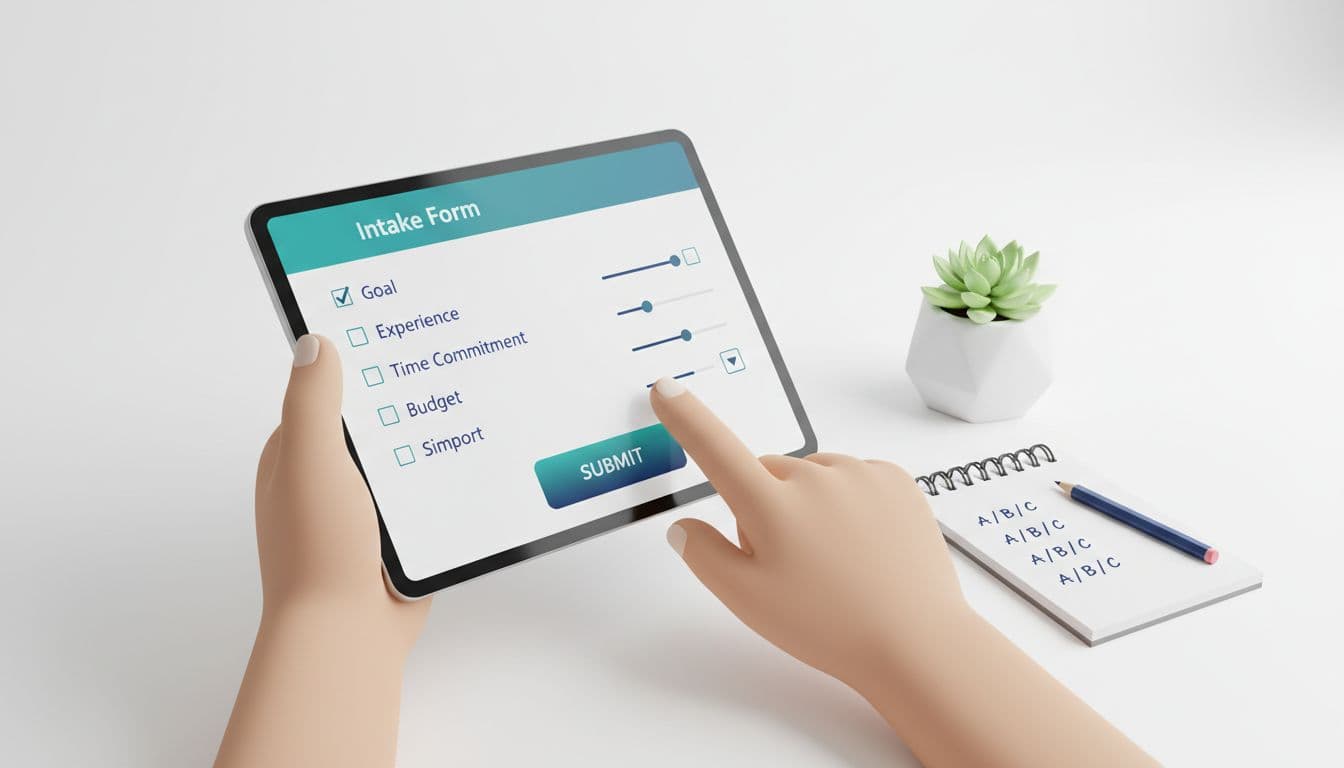
Plain-text version (copy/paste)
Form Title: Quick Fit Check (2 minutes)
What’s your main goal in the next 90 days?
(Answer: ____________)When do you want to choose a direction by?
(Answer: Today, 48 hours, 7 days, later)How many hours per week can you realistically give this?
(Answer: 0 to 1, 2 to 3, 4 to 6, 7+)What budget range are you comfortable with for a small monthly business plan?
(Answer: $0, under $25, $25 to $75, $75+)Have you tried anything like this before?
(Answer: Brand new, tried a little, have experience)How’s your support at home and with your schedule?
(Answer: Strong support, mixed, little to none)What do you want to avoid? (Pick one)
(Answer: recruiting, selling, content posting, monthly fees)
Optional: Best way to reach you
(Answer: ____________)
Table version (easy to build in any form builder)
| # | Question | Suggested answer options | Score guide (1 to 5) |
|---|---|---|---|
| 1 | Goal in next 90 days | Open text | Vague (1), specific and urgent (5) |
| 2 | Decision timeline | Today, 48 hours, 7 days, later | Later (1), 48 hours or less (5) |
| 3 | Hours per week | 0 to 1, 2 to 3, 4 to 6, 7+ | 0 to 1 (1), 4+ (5) |
| 4 | Budget comfort | $0, under $25, $25 to $75, $75+ | $0 (1), $25+ (4 to 5) |
| 5 | Experience | New, tried a little, experienced | Not coachable vibe (1), coachable (5) |
| 6 | Support | Strong, mixed, none | None (1), strong (5) |
| 7 | Fit and preferences | Avoid: recruiting, selling, posting, fees | Mismatch (1), match (5) |
Short message to send the form
“Hey [Name], so I don’t waste your time, I use a 2-minute Quick Fit Check. It helps me point you to the right option (or tell you honestly if it’s not a fit). Can you fill this out and I’ll reply with your best next step?”
What to do next: follow-up scripts for A, B, and C leads
A form is only useful if it triggers the right next action. This is where simple automated workflows help. Set one rule in your CRM software: score band = next message + next task.
If you’re building a low-cost residual model, keep your next step small and clear. This guide is a good example of how to frame a simple path without hype: Easy residual income guide with GDI Rotator.
Script for A leads (ready now): a clear call-to-action that improves conversion rates
“Thanks for filling that out. Based on your answers, you’re a strong fit. Let’s do a quick 10 to 15-minute call so I can show you the simple plan and what your first week looks like. Are you better today or tomorrow?”
Script for B leads (interested, needs clarity)
“Appreciate you. You look like a possible fit, but I want to tighten up two things (timeline and weekly hours) so you don’t start and stall. Want me to send a 3-minute overview hosted on a specific landing page first, to keep the project intake process moving forward, then we can decide if a short call makes sense?”
Script for C leads (not ready, don’t chase)
“Thanks for being honest. Right now, it looks like timing or budget is the main blocker, and that’s normal; even a marketing agency would prioritize timing and budget before moving forward. I’ll send a free starter guide you can use anytime. If your situation changes, message me ‘READY’ and I’ll reopen options.”
If your offer includes automated placement or a community-based Team Build, be extra direct about expectations. People don’t need pressure, they need clarity. This walkthrough is helpful for setting realistic expectations: How to generate passive earnings online.
A quick disclaimer (income and privacy)
Digital marketing results vary. Any examples of earnings are not promises, and there’s no guaranteed way to Make Money Online. Treat this like any business: effort, follow-through, and consistency matter.
Also, during data collection, only gather what you need. Tell leads how you’ll use their info, store it securely, and don’t share it without consent. Respecting lead privacy is a key part of the user experience. If someone asks you to delete their data, do it.
Conclusion
Pre-qualification isn’t about being picky. It’s about being fair with your time and their expectations. A simple 7-point intake form serves as a filtration system for your business, turning random chats into a clear process, and that’s what makes a Side Hustle feel manageable.
Use it as a lead magnet, or a precursor to one, to better understand your target audience. Copy the template, score your next 10 leads, and watch what happens when you focus on fit instead of chasing. Here’s your final call-to-action: try split testing different questions to see which yields the highest lead quality.