


If you’ve been trying to build a side hustle, you’ve probably noticed the hard part isn’t “the offer”, it’s the daily grind of posting, answering questions, and following up. AI Viral Downline is built for beginners and home-based business folks who want more automation and less chasing, using an AI chat assistant plus social posting tools to keep your pipeline moving.
In plain English, the core promise is simple: automation that helps with content, lead capture, and follow-up. Their AI assistant, Emily, is designed to chat with prospects 24/7, explain the business, answer common questions, and help convert interested people when you’re busy or asleep.
This 2026 guide keeps expectations grounded. Results vary, there’s no magic button, and you still have responsibilities (like staying active, learning the system, and choosing how you promote). You’ll also want to understand the costs, what’s included in the 7-day free trial (no credit card required), and what upgrading unlocks.
By the end, you’ll have a clear picture of the main moving parts: the Emily AI chat assistant, the auto-posting and social console features, how the 7-day trial works, and the 3×8 matrix payout structure (including what levels pay, and what requires referrals versus what can pay without them).
AI Viral Downline explained like you are new, what it does and what you actually get
AI Viral Downline is easiest to understand when you picture a small “automation team” working behind the scenes. One part talks to people who land on your page, another part keeps your social accounts active, and a dashboard ties it together so you can see what’s happening.
The big win for beginners is consistency without living on your phone. The big caution is just as real: automation can save time, but it can’t replace good judgment, honest marketing, and basic business understanding.
Meet Emily, the AI assistant that chats with prospects 24 7

Emily is the “always-on” chat side of AI Viral Downline. In simple terms, she’s built to greet visitors, explain the offer in plain language, answer common questions, and guide interested people toward the next step, even when you’re at work, asleep, or just not in the mood to pitch.
In real life, that usually looks like:
- Someone clicks your link, lands on a page, and starts interacting right away.
- Emily handles the repeated basics that drain your energy, things like “How does it work?”, “What do I do first?”, “What does the matrix mean?”, or “Is there a trial?”
- She keeps the conversation moving toward a decision, instead of leaving your prospect hanging for hours.
That said, Emily isn’t a magic wand, and you shouldn’t treat her like one. You still need to understand what you’re promoting, because you’re the person responsible for how you market it. If a prospect asks something specific (billing, payouts, policies, or a personal scenario), you should be ready to step in and confirm details from the official materials.
A grounded way to think about it: Emily is your first-line assistant, like a helpful receptionist. She can handle the front desk, but you still run the business.
Also, be smart about privacy and expectations. AI Viral Downline says users can unsubscribe from emails through links included in messages, and that payment details like credit cards are not stored on their servers (they also describe using secure transmission like SSL). If you want to see how they describe Emily’s role and the system at a high level, start with the official AI Viral Downline overview.
The content engine, auto-posting, trends, and analytics in plain terms

The second big piece of AI Viral Downline is the content and posting system. If Emily is the “talking” part, this is the “showing up every day” part.
Here’s what you actually get in plain terms:
Multi-platform auto-posting (with tweaks per platform): You connect your social accounts, then the system can publish content across multiple channels with settings meant to fit each platform’s style. The practical benefit is simple: you stop ghosting your audience when life gets busy.
Trend ideas plus keyword and hashtag suggestions: Instead of guessing what to post, the system looks at what’s currently getting attention and proposes topics, keywords, and hashtags. Treat that like a helpful assistant handing you ideas, not a guarantee that something will go viral.
Watermarks per account: You can add a unique watermark for each social profile, which helps keep your posts tied to your identity when content gets shared around.
One central console with analytics: You can monitor performance, see engagement, and track activity from one place. This matters because it turns marketing from “vibes” into patterns (what’s getting views, what’s getting clicks, what’s getting ignored).
The benefit is consistency, but there’s a real risk: automation can publish junk just as fast as it publishes good content. If your posts feel spammy, exaggerated, or too salesy, people stop trusting you, and platforms can reduce your reach.
A simple way to stay compliant and on-brand:
- Edit before you blast (even 30 seconds per post helps).
- Avoid income hype and stick to what you can explain and support.
- Use a value-first rhythm, helpful tip, quick story, then offer (not offer, offer, offer).
If you’re also building other low-cost systems alongside this, it can help to compare how different “automation styles” work. For example, here’s a separate model focused on team placement and simplicity: Automated team building system overview.
How the money side works, the 7-day trial, monthly cost, and the 3×8 matrix
AI Viral Downline is a mix of software plus a simple monthly membership model. You can start with a 7-day free trial (no credit card required), then decide if you want to keep your spot active by upgrading. The paid plan is $28 per month after the trial, and the upgrade is what unlocks the full commission structure.
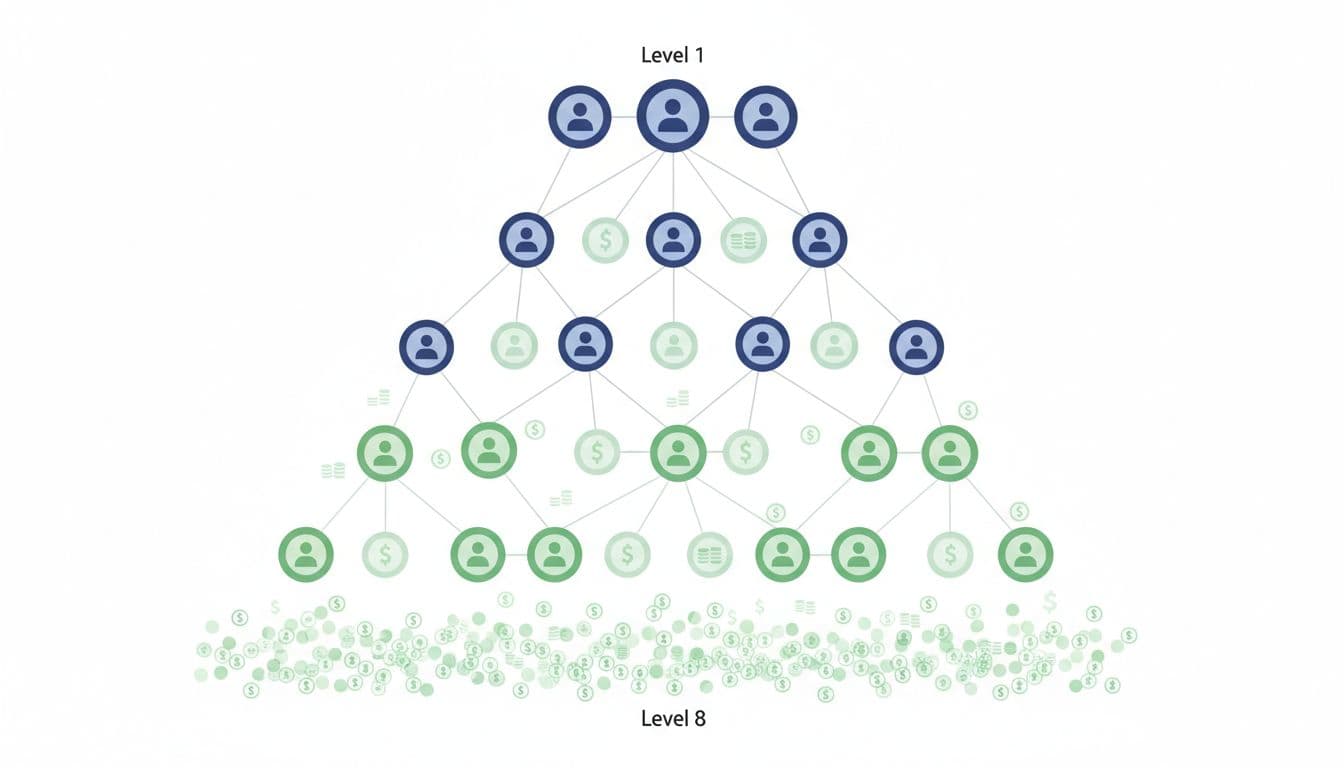
The other piece you need to understand is the 3×8 matrix. Think of it like a grid with 8 rows (levels). Each person can have up to 3 people directly under them on Level 1, and those positions branch out from there.
Matrix payouts, what the levels pay, and what a full matrix would mean
The matrix payouts in AI Viral Downline are presented as monthly residual commissions based on how many people are sitting on each level of your matrix (active members). Here’s the payout breakdown as described:
- Level 1 pays $10 per member (max 3 members on that level, so $30/month when Level 1 is full).
- Levels 2 through 7 pay $2 per member.
- Level 8 pays $3 per member, but this level is described as requiring 3 personal referrals to unlock.
If you like to see the numbers laid out cleanly, here’s what a “full matrix” would look like in theory:
| Matrix level | Positions at that level | Payout per member | Level total (monthly) |
|---|---|---|---|
| Level 1 | 3 | $10 | $30 |
| Level 2 | 9 | $2 | $18 |
| Level 3 | 27 | $2 | $54 |
| Level 4 | 81 | $2 | $162 |
| Level 5 | 243 | $2 | $486 |
| Level 6 | 729 | $2 | $1,458 |
| Level 7 | 2,187 | $2 | $4,374 |
| Level 8 | 6,561 | $3 | $19,683 |
Using those exact figures, the company’s example math adds up like this:
- Levels 1 to 7 total: $6,582/month (presented as payable even if you personally sponsor zero people)
- Levels 1 to 8 total: $26,265/month (theoretical full matrix max)
Two grounding points matter here.
First, those totals assume your matrix fills and stays filled with paying members month after month. That’s a big assumption in any membership program because people cancel, payment methods fail, and interest fades. Second, “full matrix” numbers are best treated like a capacity chart, not a forecast. Real results vary, and most people will be somewhere between “just started” and “partially filled” for a long time.
If you want to cross-check the current wording on the trial and matrix payout structure, use the official AI Viral Downline site overview.

What “spillover” and “no recruiting” really mean in real life
“Spillover” is one of those words that sounds like magic until you translate it into normal life.
Spillover means people can be placed under you because of system flow or team activity, not only because you personally enrolled them. Picture a line at a busy restaurant. If the host seats guests at the next open table, and you already have a reserved table number, you might benefit from where you’re positioned in the flow.
That’s the idea, but here’s the straight talk:
- “No recruiting” doesn’t mean no enrollments happen. It means you might not be the one doing all the enrolling.
- The matrix still depends on overall signups and retention. If new people stop joining (or lots of members quit), spillover slows down and payouts can shrink.
- Even in systems with co-op or group promotion, someone is still paying for ads, making content, and driving clicks. The “team” part is real, but it doesn’t replace the need for consistent traffic.
This is where AI Viral Downline’s pitch about automation can help. If Emily is answering questions and guiding people through the basics, that can reduce the amount of hands-on explaining you do. But traffic is still the fuel. If you don’t have a plan to get eyeballs on your link, an AI closer has nobody to close.
A simple, sustainable approach is to pick one or two traffic lanes and stick with them for 30 days:
- Short daily social posts (edited so they sound like you, not a bot)
- A simple follow-up routine (even 10 minutes a day)
- Occasional co-op or group promotion if your team offers it
If you’ve never seen how “team placement” models work in other low-cost systems, compare the concept in this guide on how GDI Rotator creates spillover and passive earnings. It’s not the same program, but the mindset is the same: position + traffic + time beats hype every time.
Is AI Viral Downline legit, what to check before joining, and who it fits best
“Legit” is a loaded word online. For most people, what they really mean is: Is it real, does it match what it claims, and can I test it without getting burned? With AI Viral Downline, the smart move is to treat it like you would any monthly software plus compensation plan. Verify the basics, read the policies yourself, then run a short trial with simple goals.
From what the platform states in its own materials, you’re getting an AI assistant (Emily) that can answer questions 24/7, plus tools for content posting and tracking. It also describes a 7-day free trial with no credit card required, and it spells out how the 3×8 matrix payouts work (including what’s required to unlock Level 8). That’s a good start, but your due diligence still matters because you’re the one linking accounts, promoting offers, and paying ongoing fees.
If you want a second opinion beyond marketing pages, scan a few independent takes like this AI Viral Downline review breakdown and compare what they say with the official pages you see inside your account.
Quick safety checklist, costs, terms, data, and support
Before you join (or before your trial ends), take 20 minutes and do a “boring but smart” review. Think of it like reading the lease before you move in.

Here’s the quick checklist that keeps you out of trouble:
- Confirm the monthly fee after the trial ends: The company describes a 7-day free trial (no credit card required), and a paid membership price of $28 per month after you upgrade. Verify what you see on the upgrade and billing pages inside your account before you commit.
- Verify how to cancel (and where): Their privacy language indicates you can cancel your account from the member’s area or by notifying them through support. Don’t assume. Find the cancel option while you’re calm, not on Day 7 at 11:58 PM.
- Save the support contact: Their policy pages list a contact route and company contact details, including a support email and contact page. Use the official AI Viral Downline support contact page so you’re not chasing random inboxes.
- Understand how email unsubscribes work: They state emails sent from their server include an unsubscribe link. That’s important if you’re testing follow-up and you don’t want extra email volume later.
- Know what happens to your data if you cancel: Their privacy wording says if you cancel, your login and website are disabled, and you stop receiving emails, but data may be kept for reporting records. If that makes you uneasy, get clarity before upgrading.
- Decide if you’re comfortable linking social accounts: The tool’s value depends on connecting platforms for auto-posting and engagement. Only connect accounts you’re okay using for business, and review permissions. If your personal profile is private or family-focused, consider using a separate business account.
Two extra steps that protect you (and take almost no time):
- Read the site’s Privacy and Terms pages, not summaries and not screenshots from someone else. Look for billing language, refunds (if any), cancellation steps, and what they store.
- Keep screenshots of key pages you relied on (trial offer page, pricing page, matrix payout explanation, and any “requirements to unlock” wording). If anything ever changes, you’ll have your own record.
This is not paranoia. It’s basic business.
A simple 7-day test plan, how to try it without getting overwhelmed
The fastest way to know if AI Viral Downline fits you is to run a short trial like a controlled experiment. You’re not trying to “get rich in a week.” You’re trying to answer three questions: Do I understand it, will I use it, and does it fit my budget?

Use this low-stress plan:
Day 1, set up the basics (30 to 60 minutes). Connect only the social profiles you truly want tied to this project. Set up whatever tracking is available in the dashboard, and write down your “why” in one sentence (extra bill money, emergency fund, debt payoff). Clarity beats hype.
Day 2 to 3, review the posts and adjust your branding. Don’t just let content fly out untouched. Make small edits so it sounds like you. Check watermarks if you use them. If you wouldn’t say it to a friend, don’t post it.
Day 4 to 5, watch conversations and collect real questions. Emily can answer routine questions, but your job is to notice patterns. What are people asking most, price, time, legitimacy, “what do I do?” Create a short FAQ note for yourself, and tighten your messaging.
Day 6, check analytics and traffic sources. Look for simple signals, not perfection: clicks, replies, profile visits, and which platform sends the best traffic. If nothing is happening, that’s feedback, not failure. It usually means you need more eyeballs or clearer posts.
Day 7, decide based on clarity, comfort, and budget. Do you understand what you’re promoting? Do you feel good about the marketing? Can you afford the monthly cost without stress? If the answer is “not yet,” pause or cancel and come back later. A rushed upgrade often turns into a rushed cancellation.
Set realistic goals for your trial. Aim to learn the system and get your first clicks, not instant income. If you want a steady framework to pair with tools like AI Viral Downline, follow a simple schedule like this Step-by-Step 90-Day Side Hustle Blueprint so your actions stack week to week instead of feeling random.
How this compares to other low-cost team build systems (and when it makes sense to choose one over the other)

Most low-cost team build systems fall into one of two buckets:
- Automation-first systems that try to reduce your daily workload (content, follow-up, replies).
- Placement-first systems that focus on getting you started fast with basic steps and team flow.
AI Viral Downline sits firmly in the first bucket. You are not just buying a “position.” You’re paying for tools designed to keep your marketing moving, even when you’re busy. That can be a big deal if your real problem is consistency, not motivation.
If you like automation and content help, this is the main reason people pick it
If you’ve ever told yourself, “I’ll post tonight,” and then a week disappears, AI Viral Downline is aimed right at that pain point. The main draw is not the matrix math. It’s the idea that you can stop doing everything by hand.
Here’s where the fit is strongest:
You struggle with daily posting. AI Viral Downline is built around a content workflow (ideas, templates, publishing), so you’re not starting from a blank screen every day. Having prebuilt formats helps you stay active, even on low-energy days.
You don’t want to live in your DMs. Emily is positioned as an always-on assistant that can answer common questions and keep conversations moving while you work, sleep, or spend time with family. Think of it like having a front-desk person who can handle the routine questions so you only step in when it matters.
You want one place to manage the moving parts. A single console for posting, basic engagement, and performance tracking removes a lot of tab-hopping. The practical win is speed. You can check what’s working, adjust, and move on.
You care about feedback, not vibes. Built-in analytics matter because they give you a simple signal: which platform is sending clicks, which posts get ignored, and where you should spend your limited time.
That said, automation can’t do the “human” parts for you. You still need to:
- Stay honest in your claims (no hype, no wild income talk, no pressure language).
- Stay consistent with light daily activity, even if it’s 10 minutes.
- Stay present enough to build trust (people can smell copy-paste a mile away).
A good comparison point is a stand-alone referral marketing tool like UpViral’s referral campaign platform. Tools like that can help you collect leads and drive shares, but they don’t usually come with an embedded “assistant” designed to explain your offer for you. AI Viral Downline is more of an all-in-one setup (assistant plus posting), which is why some people accept the monthly fee.
If you want the simplest possible start, consider a basic team build approach too
Sometimes the best choice is not “more features.” It’s fewer steps.
If you’re brand new, or you’re coming off a start-stop history with online programs, a basic team build approach can be the calmer on-ramp. These systems usually focus on:
- Low monthly cost and fewer moving parts.
- Simple team placement concepts (get in, get positioned, follow the steps).
- Learning fundamentals like posting a basic routine, using simple scripts, and tracking your own activity.
This route can make sense if you want to build the habit first, then add tools later. It’s like learning to cook with a few solid meals before you buy every gadget. You get your reps in without feeling like you need to master a dashboard, connect accounts, and monitor analytics on day one.
Use this quick “choose your lane” filter:
- Pick AI Viral Downline if your biggest bottleneck is execution (posting, follow-up, DMs), and you’re willing to trade a bit of money for saved time and structure.
- Pick a basic team build system if your biggest bottleneck is clarity and routine, and you want the lightest setup possible while you learn.
The truth is, both paths still require the same foundation: show up, talk to real people, keep your message clean, and give it time. The tools can help, but you are still the trust factor.
If you want to browse beginner-friendly options and compare different low-cost models, start here: home business opportunities category.
Conclusion
AI Viral Downline is a simple idea packaged as a system: you get an always-on chat helper (Emily) plus auto-content and posting tools that help you stay consistent, then you earn through a 3×8 matrix if your levels fill with active members.
Here are the takeaways that matter most: it’s built to answer questions and follow up 24/7 through Emily, it includes multi-platform posting, trend ideas, and basic tracking, the 7-day trial is free with no credit card required, and the upgrade is $28/month to unlock the full commission structure. The matrix pays $10 per member on Level 1 (up to three), then $2 per member on Levels 2 to 7, and Level 8 is $3 per member but requires three personal referrals to unlock. Those “full matrix” numbers are capacity math, not typical results, because real payouts depend on traffic, signups, and people staying paid month after month. Read the Terms and Privacy pages before you link accounts, pay, or promote, especially around cancellation, email unsubscribes, and what data is stored.
If you want a clean next step, start the trial from https://aiviraldownline.com, treat the week like a learning sprint, track clicks and real conversations, then decide based on budget and comfort level. Thanks for reading, your best results come from calm consistency, not hype.