


Most beginners don’t struggle because they’re lazy. They struggle because they’re buried in choices.
One program turns into three. One “simple funnel” turns into eight tools. And somehow the only thing that doesn’t grow is your income, because your time gets split into tiny pieces.
The “Top of Your Team” plan is a beginner-friendly way to stop the spinning and start stacking results. Even if it’s just you, you act like the leader of a tiny team. You build the top layer first, the basics everything else sits on: one offer, one lead source, one weekly schedule. Then you repeat it long enough for it to work.
This isn’t a get rich quick plan. It’s a consistency plan. The kind that can turn into steady income over time for side hustlers, home-based business starters, and anyone who wants a calmer way to build online.
Start with one offer that solves one clear problem

Beginners lose months by stacking offers. They join one thing, then hear about a “better” thing, then switch again. The problem isn’t your motivation, it’s the moving target.
Your first job is to pick one offer you can explain clearly and promote consistently. It can be a product, a service, or an affiliate offer. What matters is that the message stays the same for long enough that people start to recognize what you do.
Use this simple rule: pick one offer you can explain in one sentence, to one type of person, with one main benefit.
If you want a grounded example of what “real offer clarity” looks like (and how to keep hype out of it), this breakdown helps: real product and real income expectations.
Here’s a quick “simple enough” checklist:
- Clear result: someone knows what changes after they say yes
- Clear price: no mystery math or “DM me for details” pricing
- Easy next step: one button, one form, or one reply to start
Clarity is your first conversion tool. Not your logo, not your autoresponder, not your branding colors.
The one sentence offer test (if you can’t say it fast, it’s not ready)
Say your offer out loud. If it takes longer than one breath, you’re not ready to promote it yet.
Fill in the blank:
“I help (who) get (result) without (pain) using (method).”
A few beginner-friendly examples:
“I help busy parents start a low-cost home-based business without tech stress using a simple weekly plan.”
“I help new affiliates collect leads without chasing friends using a one-page capture setup.”
“I help side hustlers set up a basic domain and simple website without getting stuck using a quick start call.”
Keep the promise small and believable. You’re selling a first win, not a fantasy life.
Build a basic offer page that answers three questions
You don’t need a fancy site to start, you need an offer page that removes confusion. Aim for one page that answers:
- What is it?
- Who is it for?
- What happens next?
Keep it simple:
- A short headline that matches your one sentence offer
- Three benefits (plain language, no buzzwords)
- Simple proof (a short story counts if you’re new)
- One call to action (apply, buy, book, or reply)
You can improve later. Right now, the goal is one clear next step, every time.
Pick one lead source you can stick with for 90 days
A lead source is where attention comes from, where people see you and start to trust you. Most beginners fail here because they try to be everywhere. Facebook, TikTok, YouTube, Instagram, email, blogging, and paid ads, all at once.
Pick one lane. Run it for 90 days.
Choose based on three things: you don’t hate it, you can do it weekly, and your people are already there. Organic first, paid later. If you can’t make free traffic work, paid traffic usually just helps you lose money faster.
If your lead source includes social profiles, don’t ignore the “bridge” between interest and action. A clean link setup matters more than most people think. Use this as a guide: a practical link-in-bio setup for lead generation.
Simple choices that work for beginners (and what to post)
Facebook profile and groups work well if you like writing and conversation. Post quick tips, short stories (what you tried, what happened), and “mistake to avoid” lessons. Then invite people who comment to a simple freebie or your offer page.
YouTube short videos work well if you can talk for 30 to 60 seconds without overthinking it. Share a quick how-to, a simple warning, or a small win. Don’t chase perfection, chase consistency.
Basic email list building works well if you want a calmer follow-up system. You post somewhere (Facebook or YouTube), offer one free checklist, capture an email, then follow up. Email is still one of the best “assets” you can own because you’re not at the mercy of a platform.
Whatever you choose, use a “post then invite” pattern: you post something useful, then invite interested people to one next step.
How to track leads without getting overwhelmed
You don’t need a CRM to start. You need a follow-up habit.
Use one simple sheet with five columns:
| Name | Contact method | Date started | Next follow-up | Status |
|---|---|---|---|---|
| Jordan | FB DM | Jan 10 | Jan 13 | New |
| Casey | Jan 12 | Jan 16 | Interested |
Your goal isn’t perfect tracking. Your goal is momentum.
One rule keeps you sane: never let a lead sit without a next step. If “next follow-up” is blank, you’re guessing, and guessing kills consistency.
Your weekly schedule, the minimum work that moves the needle
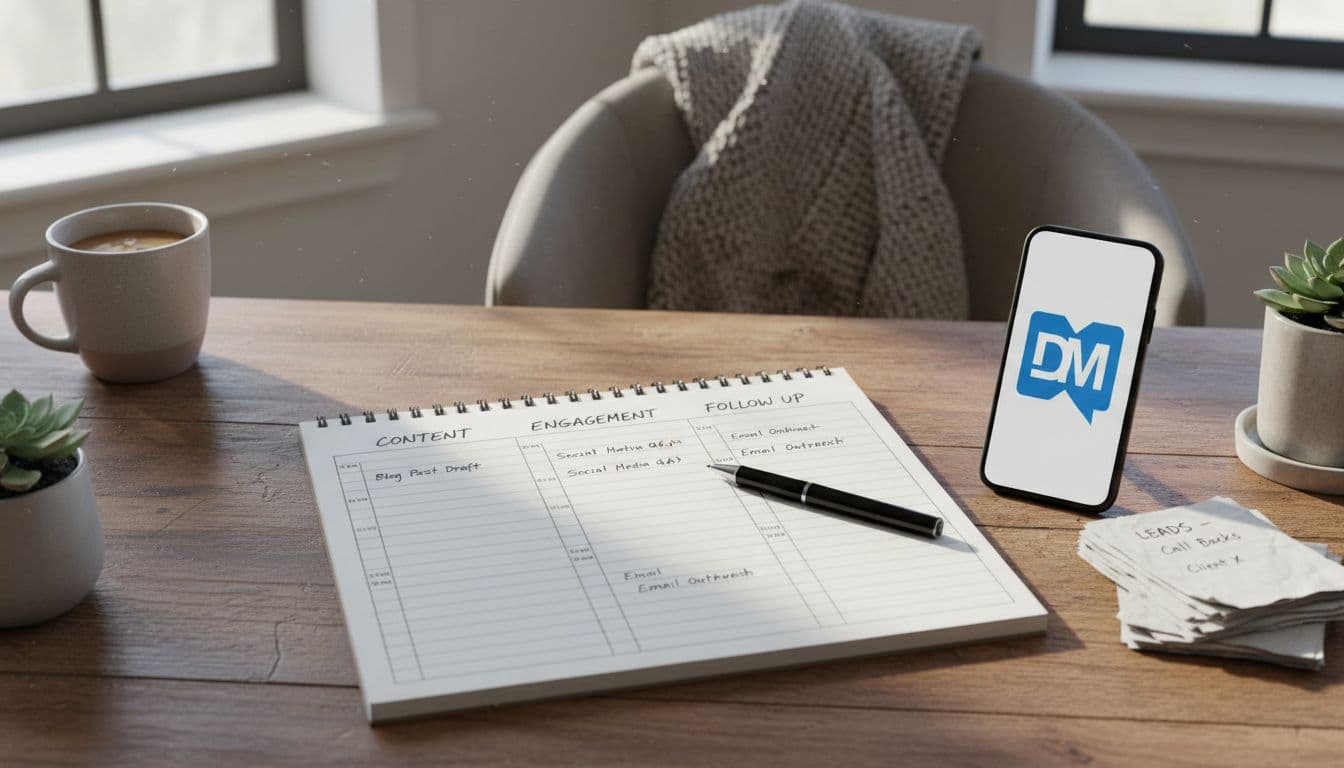
This is the part most people skip. They “work the business” only when they feel like it, then wonder why income stays random.
Your schedule is the system. It’s the leader of your tiny team.
Aim for 4 to 6 hours per week, total. Busy is normal. You’re not trying to build a second full-time job. You’re trying to build a repeatable rhythm that creates trust, starts conversations, and makes offers.
If you want a longer runway plan that matches this approach, this pairs well with what you’re building here: a step-by-step 90-day side hustle plan.
A 4 to 6 hour weekly plan you can repeat every week
Here’s a simple structure:
- 1 hour content batch: write or record 2 to 3 posts at once
- 2 hours engagement: comments, messages, and real conversations
- 1 hour follow-up: check your sheet, send the next message
- 1 hour learning and improving: fix one small bottleneck
- Optional 1 hour calls: quick chats or short intro calls
If life hits and you miss a day, don’t “start over Monday.” Just do the next block the next day. Consistency is a habit, not a mood.
Give yourself one weekly metric target to keep it real. Example: 3 posts, 10 conversations started, 5 follow-ups, 1 clear offer made.
If you’re short on time, do a daily 15-minute version: one post (or one comment thread), two messages, and one follow-up. Small actions stack faster than you think.
The “Top of Your Team” mindset: lead yourself first
“Top of your team” means you build the top layer first: the decisions and routines that hold everything up. When you do that, your business stops feeling like chaos.
Three common beginner mistakes show up again and again:
Changing offers weekly: You never get traction because you keep resetting trust. Fix it by committing to one offer for 90 days.
Buying tools before traction: Tools feel like progress, but they don’t replace conversations. Fix it by earning your first leads manually, then upgrade.
Waiting to feel ready: Ready is a result of reps. Fix it by taking small public actions, even if they’re imperfect.
Your job is to show up when it feels slow. That’s how you stop building “someday” and start building results.
What to automate later, after the basics are working

Automation is helpful, but only in the right order.
Do it manual first so you learn what works. Then automate what you’re already doing. If you automate too early, you often lock in weak messaging and avoid the real skill (talking to people and making clear offers).
If your offer is built around a team system or affiliate model, it’s smart to understand how “automated placement” style systems are positioned, and what problems they solve for beginners. This article explains the idea without sugarcoating it: how the GDI Rotator is positioned for automated income.
The first three automations that save the most time
Add automation after you’re consistently getting about 10 to 20 leads per month (or when follow-up starts slipping).
A simple welcome email sequence for new leads
Send the freebie, share a short story, ask one question, invite the next step.A calendar link for calls or quick chats
This cuts back-and-forth and keeps your schedule clean.Content and follow-up templates
Not spam scripts, just repeatable frameworks you can personalize fast.
Then use a “set it once, review monthly” habit. You don’t want to babysit tools. You want tools that support your routine.
A simple funnel map you can draw on paper
Draw it like a straight line:
Post content, start conversation, offer a free step, capture email, follow up, invite to offer, onboard customer.
That’s it.
The goal is one clear next step at each point. Not a fancy funnel, not a complicated website, not ten choices. Keep your messages honest and human. The more normal you sound, the more people reply.
Conclusion
The “Top of Your Team” plan is simple on purpose: one offer, one lead source, one weekly schedule, then automate later.
Beginners win by staying with one clean plan for 90 days, long enough for trust and momentum to build. Pick your one sentence offer today, choose one lead source, and schedule your first four hours on the calendar this week. Your future income wants consistency, not more ideas.