

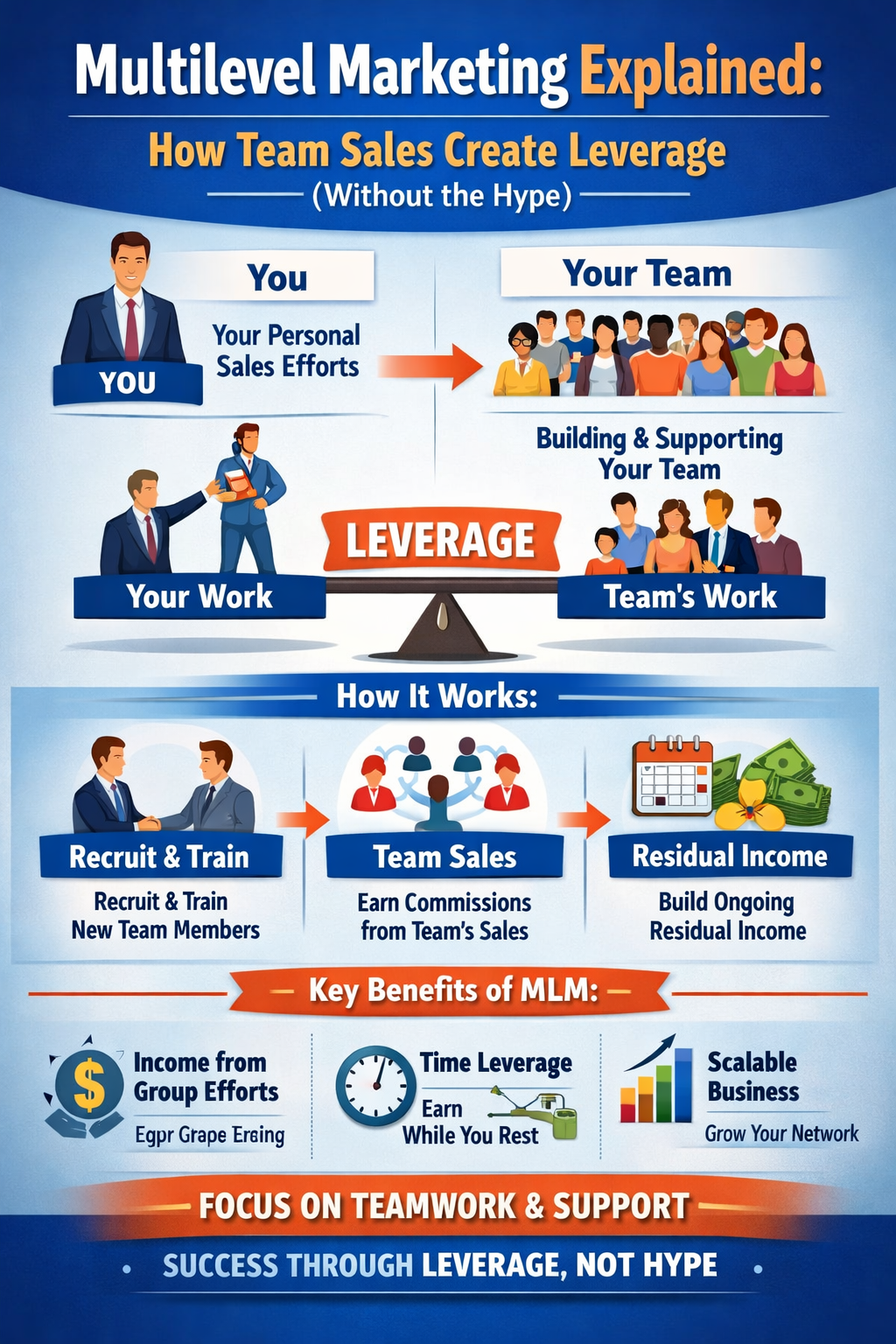
If you’re searching for ways to make money online, Multilevel Marketing (MLM) can look tempting because it offers two possible income streams in one: selling a product and building a team that sells with you.
In plain terms, MLM is a direct selling business where you earn from your own sales, and you can also earn small commissions from the sales of people in your organization. That second part is what many people call Leverage (your results aren’t limited to only your personal effort).
This post will help you understand how MLM works, what “team-based” earnings really mean in real life, and how to spot unrealistic promises before you spend money or time.
What Is Multilevel Marketing, and How Does It Work?
Multilevel Marketing is a business model where a company sells products through independent sellers (not traditional retail stores). You sign up as a seller, learn the products, and earn money when products are sold.
Here are the core terms, in simple language:
Distributor: The person who joins the company to sell (this could be you).
Retail profit: The money you keep when you buy at a lower price and sell at a higher price.
Commission: A percentage you’re paid based on sales volume (yours or your team’s).
Upline: The person or team above you who recruited you.
Downline: The people you recruit, plus the people they recruit (your organization).
Levels: The “layers” of people under you (first level is who you directly enroll).
The basic flow usually looks like this:
- You join the company and get access to products and a compensation plan.
- You sell products to customers and earn retail profit and or commissions.
- You can also recruit other distributors.
- If your team sells products, you may earn commissions based on that group sales activity (how much depends on the plan and your rank).
Most companies explain that commissions are tied to product sales, not just recruiting. That’s a key point because recruiting alone is where things can start to look like a pyramid setup. Plans also differ a lot, some focus heavily on personal sales, while others pay more when group volume grows. If you want a broad overview of how network marketing is commonly described (with examples), this guide is a useful baseline: https://www.shopify.com/blog/network-marketing.
How MLM pay is structured: retail profit, team commissions, and bonuses
MLM income usually comes from a few buckets:
Retail profit: You sell a product to a real customer and keep the margin.
Team commissions: You get a small percentage of sales volume generated by your downline.
Rank bonuses: Some plans pay extra when you hit certain ranks (often tied to volume and structure).
Activity requirements: Many plans require monthly sales or personal volume to stay “active.”
A simple example (numbers will vary by company, this is simplified):
- You personally sell $500 of product in a month and earn $100 in retail profit.
- Your team sells $10,000 that month. Your plan pays you 3 percent on that volume, so you earn $300.
- Total for the month is $400 before expenses.
That’s the basic idea: personal selling plus a smaller cut of group sales.
Why it’s called “multilevel”: the role of levels and volume
It’s called “multilevel” because you can be paid from more than one layer of your downline, not only the people you personally enrolled. How deep you get paid often depends on rank, rules, and whether you stay active.
You’ll also hear the word volume. Volume is usually a points-based number tied to product sales, not always straight dollars. Some products may count as more or less volume. Many plans require a minimum monthly volume to qualify for team commissions, which means if you stop selling, your eligibility can drop even if your team is still moving product.
If you want extra context on common MLM structures and terms, this overview can help you compare what you’re reading in a compensation plan: https://www.epixelmlmsoftware.com/blog/what-is-mlm-multi-level-marketing
How You Earn With Leverage in an MLM Organization (and What It Really Takes)
Leverage in MLM sounds like this: “I build a team, they sell too, and I earn from the whole group.”
That can be true, but only when a few real-world pieces are in place:
- People actually want the product at the price.
- Your team stays active long enough to build momentum.
- You keep your personal activity high enough to stay qualified.
Think of it like opening a small coffee stand. If you’re the only barista, your income has a ceiling. If you train three solid baristas and they each serve customers well, the stand can serve more people than you could alone. But you still have to manage quality, schedules, and turnover. MLM works the same way.
The upside is real: you can earn from many small sales. The friction is also real: you’ll spend time coaching, fixing gaps, and replacing people who quit.
Leverage explained: you earn a small piece of many sales, not one big payday
In most plans, team payouts are not huge per sale. They’re designed to be small percentages that add up when volume grows.
That’s why the best mental model is:
Leverage = many small slices, stacked over time.
If your organization is inactive, the Leverage disappears. If only two people order once and quit, there’s nothing to build on. Also, most companies pay higher percentages at higher ranks, but ranks often come with ongoing volume rules. In other words, you don’t “set it and forget it.” You build, then you maintain.
A steady approach beats a frantic one. Focus on repeatable actions that make sales normal, not special.
What leaders actually do to keep leverage working: training, support, and retention
If you want team commissions to last, you need systems that reduce confusion for new people. Leaders who last usually do a few boring things consistently:
Simple onboarding: Help a new distributor set up their account, product story, and first customer list in 30 to 60 minutes.
A basic sales script: Not spammy. Just a short message that starts conversations and asks about needs.
Product education: What it is, who it’s for, how to use it, and what to avoid claiming.
Weekly check-ins: A 15-minute call or message thread that tracks small goals.
Customer-first habits: Encourage real customers, not just distributor autoships.
Retention matters because churn is common. People join with big expectations, then life gets busy. Your job as a leader is to keep the business light enough that they can keep going. Small wins keep people around longer, and longer retention is what makes Leverage real.
MLM Reality Check: Pros, Cons, and How to Avoid Pyramid Scheme Traps
MLM isn’t automatically “good” or “bad.” It’s a model. The outcome depends on the company, the product, the costs, and your ability to sell to real customers.
Here are the most common pros and cons in plain terms.
Pros:
- You can start without building a website or creating your own product.
- Training and community can help if you need structure.
- Team commissions can grow if there’s real demand and consistent activity.
Cons:
- Monthly costs can add up (autoship, tools, events, samples).
- Many people quit, which makes building slow.
- Some marketing in the space is loaded with big claims and thin details.
Your safest move is due diligence. Read the compensation plan. Ask for the income disclosure statement. Review refund and buyback policies. Track your monthly costs on paper, not in your head. Also, never go into debt to “qualify.”
Signs an MLM is more about products than recruiting (and what to ask before joining)
Use this quick checklist before you join:
Real customers exist (people buy without joining).
Pricing makes sense compared to similar products.
Starter costs are reasonable, not a huge buy-in.
Refund or buyback policy is clear and easy to find.
Income disclosure is available and not hidden.
No pressure to stockpile inventory to “get paid.”
If you can’t picture selling the product without talking about the business, pause.
Red flags that look like a pyramid scheme: big income claims, pay for recruiting, and forced inventory
Pyramid schemes are illegal, and they often collapse because they require endless recruiting to keep money flowing.
Watch for these warning signs:
Recruiting is the main product (sales talk is mostly about joining).
Big income promises with no data, timelines, or typical results.
Large required purchases to unlock commissions.
Monthly forced inventory that piles up at home.
Lifestyle marketing that’s louder than product value.
“Get in early” pressure like you’re buying a position, not building customers.
If the plan only works when you recruit nonstop, it’s not a stable business.
Conclusion
Multilevel Marketing is product-based direct selling with a team commission layer built in. Done right, Leverage can grow your income because you earn a small piece of many sales, not only your own, but it’s never automatic and it doesn’t replace real customer demand. Before you join anything, read the compensation plan, review the income disclosure, and write down your true monthly costs. Then make a simple decision: can you sell the product to real customers without relying on recruiting as your main plan?