


If you’re trying to Team Build as a beginner, the hardest part usually isn’t the product, it’s the time. Most people quit because daily “MLM work” feels like a two-hour project, and life doesn’t give you that kind of space.
This beginner plan is a simple 15-minute AI daily routine built for a Side Hustle or Home Base Business. You’ll use Automation to keep content moving, follow-up consistent, and your basics tracked, without chasing friends and family. Stick with it for 14 days and you’ll have a repeatable habit, daily content output, a simple follow-up loop, and basic tracking you can actually keep up with.
This is not a promise to Make Money Online fast, and there are no income guarantees. It’s also not a substitute for learning your offer, staying compliant, or doing real relationship-building (AI just handles the busywork). If you’re also exploring low-cost systems built around automation, start with this breakdown of Automated placement for passive income, then come back and follow the 7 Day Free Trial routine.
What “MLM Team Growth” Means When You Only Have 15 Minutes a Day
When you only have 15 minutes a day, MLM team growth can’t mean “do everything.” It means you run a small daily system that creates movement: a few new eyeballs, a few new hand-raises, a few real chats, and the occasional new signup.
Think of it like pushing a flywheel. One push won’t do much. Daily pushes add up, and after 14 to 30 days, it starts turning on its own because your content keeps bringing in signals you can follow up on.

The 4 Outcomes to Measure (Even If You’re New)
You don’t need fancy tools to track growth. You just need four outcomes and one simple signal for each. These signals tell you if your daily routine is working, even before money shows up.

Here are the four outcomes to measure, and the beginner-simple signal to watch:
- Views (attention): Your post gets watched, read, or seen. Signal: view count or reach goes up.
- Opt-ins (hand-raise): Someone requests more info. Signal: email opt-in or form submission.
- Replies (conversation): Someone responds in DM, text, or email. Signal: “Send me info”, questions, or even a simple “thanks”.
- Signups (action): Someone joins your trial, registers, or becomes a customer. Signal: confirmation email or new member notification.
A quick mindset shift: replies are a win, even if they don’t join today. If you’re new, replies prove you’re getting real humans into your world.
If you want help creating consistent daily posts fast (so you can spend your 15 minutes on follow-up), use the free social media content generator for MLM.
Why Most Beginner DMO Plans Fail (And How This One Avoids It)
Most beginner DMO plans fail for predictable reasons, not because you’re lazy.
They usually break down in four places:
- Too many steps: Post, comment, message 20 people, run stories, make a reel, do training, build a funnel, join three groups. That’s a two-hour plan pretending to be a 15-minute plan.
- No timeboxing: Without a timer, “quick follow-up” turns into scrolling, tweaking, and overthinking.
- They rely on motivation: Motivation is unreliable. A routine needs to work when you’re tired, busy, or not feeling it.
- No tracking: If you don’t track basic signals, you can’t tell if you’re improving. Then you quit because it feels like nothing is happening.
This routine avoids the mess by acting like a fixed daily method of operation. Same time block, same order, same micro-goal.
Your job is not to “work your business all day.” Your job is to do the 15 minutes, log the signals, and stop. That’s how you stay consistent long enough to see compounding results.
If you need the bigger picture of what sustainable MLM growth looks like (without hype), this beginner-friendly multilevel marketing tips guide helps anchor the mindset.
Pick One Growth Lane (Default: Content-Led)
With 15 minutes a day, you can’t run three strategies at once. Pick one lane so your brain stops juggling.
The default lane is content-led. That means you post short, simple content that creates inbound signals (views, opt-ins, replies) so you’re not stuck chasing strangers every day.
Content-led works for beginners because:
- It’s repeatable. One post a day is doable.
- It’s forgiving. Even if your message is not perfect, you still get feedback signals.
- It creates inbound follow-up. People who reply or opt in are easier to talk to than cold DMs.
- It builds a library. Posts stack, and older posts still bring in new people later.
Two optional growth lanes you can add after the habit sticks:
- Follow-up-led: When you already have leads coming in (email list, DM list), you spend most of your 15 minutes on replies and follow-ups.
- Community-led: When you have a small base, you build deeper trust through groups, live Q&A, and team check-ins.
If you’re building your routine around content, make sure your bio link is set up to catch the hand-raises. This guide on the network marketing bio link setup shows a simple structure that turns clicks into conversations.
Realistic Time Window: 14 Days Minimum, 30 Days Ideal
If you want this to work, set a realistic runway. Consistency beats intensity every time, especially for beginners.
- 14 days minimum: long enough to stop feeling awkward, collect basic signals, and tighten your message.
- 30 days ideal: long enough to build a real content trail, see which posts create replies, and get a steady flow of follow-ups.
This is also where a simple effort disclaimer matters: results vary, and there’s no guaranteed income. What you can control is repetition and improvement. Each week, your message gets clearer, your follow-up gets calmer, and your timing gets tighter.
A good goal for week 1 is not “signups.” It’s proof of motion:
- more views than last week
- at least a few opt-ins or replies
- one simple conversation that feels natural
Stack those wins for 30 days, and team growth stops feeling like guesswork. It starts feeling like a system.
The One-Time 30-Minute Setup That Makes the Daily 15 Minutes Possible
The daily 15-minute routine only works when you remove decisions. If you sit down each day and have to figure out where to send people, what to say, and what to post, your “15 minutes” turns into a half-hour of second-guessing.
This is the one-time setup that fixes that. Think of it like laying down train tracks. Once the tracks are in place, the train (your daily routine) can run on time, even when you’re tired or busy. Your goal is simple: build a beginner funnel that moves people from content → conversation → lead capture page → overview/next step, without pushing or chasing.

Setup Checklist: Assets (Offer Link, Lead Capture Page, Next Step Page)
You only need three assets to make a beginner funnel work. Each one has one job, and when you keep the jobs separate, your routine stays clean.
- Offer link: The single URL that points to your main offer or trial, used only after someone has shown interest and asks for details.
- Lead capture page: A simple mobile-friendly page that collects contact info (usually name and email, sometimes phone) so you can follow up consistently.
- Next step page: The page people see right after they opt in, it tells them exactly what to do next (watch a short overview, reply with a keyword, or book a call).
Here’s how those pieces fit the beginner funnel you’re building on any platform (IG, TikTok, Facebook, YouTube Shorts):
- Content creates a signal (a view, comment, or DM).
- Conversation earns permission (“Want the details?”).
- Lead capture turns interest into a trackable lead (so you’re not living inside DMs forever).
- Overview/next step gives them one clear action (so they don’t wander off).
Keep the lead capture page short. Real-time best practices still point to simple forms and mobile-first design, because most clicks come from phones. If you want a deeper look at building steady lead flow, review this guide on daily home business lead generation system.
Setup Checklist: Message Templates (2 Cold, 2 Warm, 1 Thanks-for-Watching)
Templates are not about sounding robotic. They’re about preventing the “what do I say?” freeze that hits when you’re new, tired, or trying not to be pushy.
Write your templates to be short, polite, and permission-first. Also, don’t drop links in the first message. Earn the ask first. When someone says “yes,” then you send the lead capture page (not your full offer link).
Here are five templates you can customize. Keep them in your notes app so they’re always ready.
Cold #1 (comment or new follower):
“Hey [Name], thanks for connecting. Quick question, are you looking for extra income right now, or just networking?”
Cold #2 (reply to a story or short video view):
“Appreciate you checking that out. What part caught your attention, the time freedom side or the extra money side?”
Warm #1 (they comment positively):
“Thanks for the comment, [Name]. Want me to send the simple overview I used to get started?”
Warm #2 (they ask ‘what is it?’):
“Totally. I can share it, do you want a quick video overview or a written breakdown?”
Thanks-for-watching (after they view your overview):
“Thanks for watching, [Name]. If you want, I can send the next step. What do you want most right now, extra income, time freedom, or a plan that’s beginner-simple?”
Best practice across platforms is still fast, human replies. Short messages build trust, and permission-first language keeps you compliant and calm.
Setup Checklist: Content Prompts (10 Post Ideas + 10 Reply Starters)
Your content does not need to be fancy. It needs to be consistent and clear. The goal is to post in a way that makes the right people raise their hand, so your 15 minutes goes to real conversations, not random scrolling.
Use five categories to keep variety without overthinking: pain, story, tip, proof, behind-the-scenes.
Here are 10 post ideas you can rotate:
- Pain: “The real reason most people quit a side hustle (it’s not effort).”
- Pain: “If you only have 15 minutes a day, stop doing this one thing.”
- Story: “Why I started building income from home (no hype version).”
- Story: “My first week: what felt awkward, what worked anyway.”
- Tip: “My 2-sentence DM that gets a ‘yes’ without pressure.”
- Tip: “How I follow up without bugging people.”
- Proof: “A simple screenshot-style update (views, replies, leads), not income.”
- Proof: “What a ‘good week’ looks like before signups happen.”
- Behind-the-scenes: “My 15-minute routine on a timer (real life edition).”
- Behind-the-scenes: “My notes app: the templates I reuse daily.”
To reduce reply friction, keep 10 reply starters ready (comments or DMs). These keep you sounding human when you’re moving fast:
- “Appreciate you saying that.”
- “That’s a fair question.”
- “Quick yes or no first.”
- “What are you hoping to change this month?”
- “Do you want the short version or the full version?”
- “What have you tried so far?”
- “No pressure either way.”
- “If I send it, will you actually look at it today?”
- “Want the overview link or the steps in a message?”
- “If it’s not for you, I’ll still help where I can.”
Short-form platforms reward simple hooks and quick value. Your job is to show up daily, not to perform.
Setup Checklist: Tracking (Daily Scorecard + Weekly Review Note)
Tracking is what keeps beginners consistent, because it turns “I feel like nothing is happening” into actual feedback. Keep it light. If tracking takes more than 60 seconds, you won’t stick with it.
Use this exact daily scorecard (copy into Notes, Google Sheets, or a simple tracker):
- Posted (Y/N)
- New DMs sent
- Replies received
- Leads captured
- Overview video views
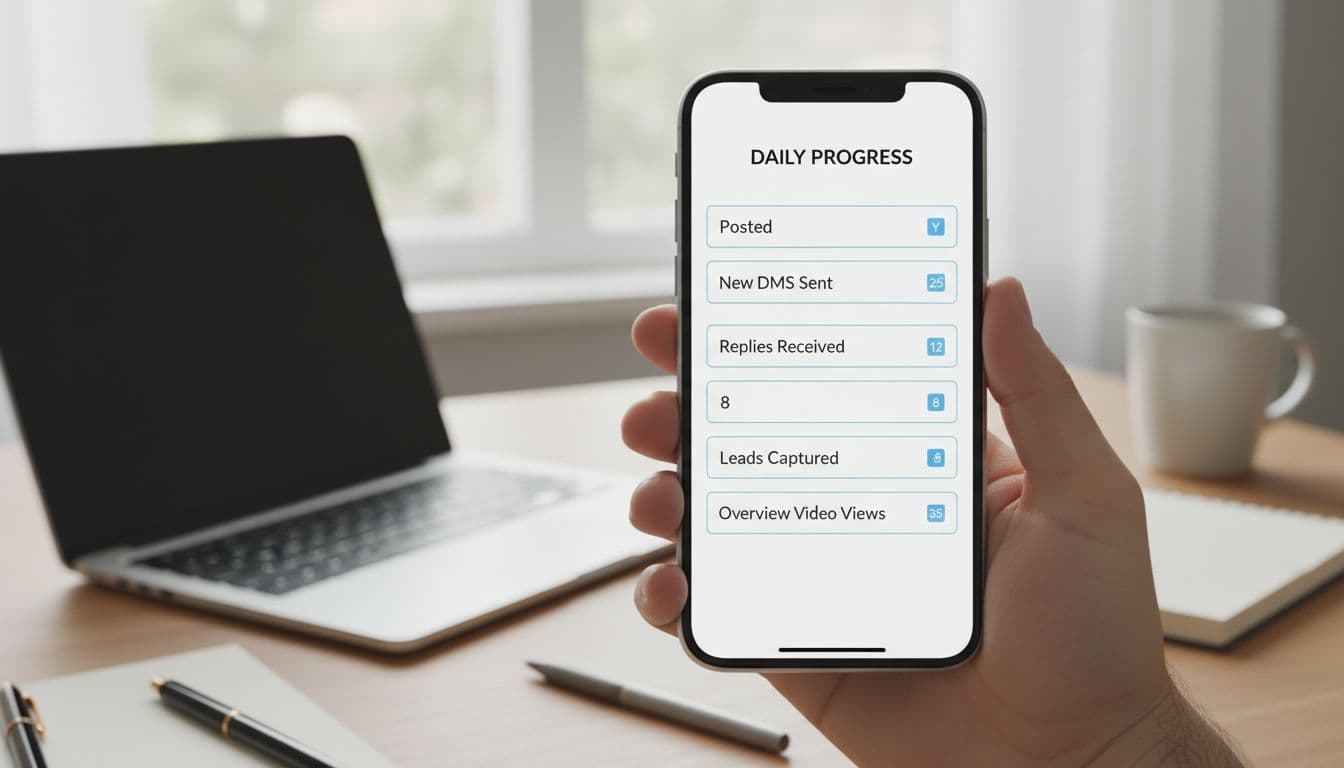
Then, once per week, write one short weekly review note (5 minutes, same day each week):
- What worked (which post or message got replies)
- What to repeat (same angle, same hook, same CTA)
- What to drop (anything that got ignored or felt forced)
This is how you improve without guessing. Over 7 days, you’ll start seeing patterns. Over 30 days, you’ll have a routine that runs even when motivation doesn’t.
Tool Examples (No Hype): Where AI Fits in a Beginner MLM Daily Plan

AI tools help most when they remove friction, not when they replace you. In a beginner 15-minute routine, the best use of AI is handling the repeat stuff: draft replies, sort conversations, remind you who needs a follow-up, and keep your “next step” consistent.
Think of AI like a cashier at a busy coffee shop. It keeps the line moving, but you still decide what’s on the menu, how you treat people, and what you stand for.
AI Viral Downline: Where It Can Help When Time Is Tight
If your biggest problem is, “I get messages, but I can’t keep up,” an AI agent-style tool like AI Viral Downline can be useful. The practical value is not magic recruiting. It’s communication support.
Here’s where it fits inside a beginner daily plan:
- Drafting replies fast: When someone asks the same five questions (cost, time, “is this MLM?”, “what do I do?”, “how do I start?”), AI can draft clean answers you can personalize in seconds.
- Organizing follow-ups: Instead of trying to remember who said what, the system can help track conversations, tags, notes, and timing so you don’t lose warm people in your inbox.
- Handling routine questions: Tools like this often focus on “smart engagement,” responding to common comments or messages quickly, and keeping leads moving to the next step (lead capture, overview, or booking).
- Keeping activity in one place: Many AI agent dashboards include logs and reporting (calls, conversations, usage), which helps you see what happened without digging through apps.
The right way to use it is simple: AI drafts, you approve. You’re still the responsible adult in the room.
A few non-negotiables if you want trust and long-term growth:
- Human review every time: Don’t blindly send AI-written messages. Read it, tighten it, make sure it matches your tone, and remove anything that sounds pushy.
- No mass unsolicited messaging: Automation is not a hall pass to spray DMs. Message people who asked for info, replied to you, or opted in.
- Don’t pretend the AI is a human: If you use an AI assistant, don’t frame it like it’s “you typing in real time” when it’s not. Trust is hard to earn and easy to lose.
- Respect opt-outs immediately: If someone says “stop,” “remove me,” or “not interested,” honor it right away. Don’t keep following up because “the system says to.”
Used correctly, AI can keep you consistent when life is busy. Used carelessly, it can burn your reputation in a weekend.
GDI Smart Rotator: Where It Fits for Team Build Support
A rotator tool is different from a messaging tool. Messaging tools help you talk to leads. A rotator-style system helps with placement and team structure after someone takes action.
With the GDI Smart Rotator approach, the big idea is that beginners should not feel forced to chase friends and family just to get momentum. Instead, the system uses a rotation to place new signups into the team structure, creating a form of spillover that helps people who are new, stuck, or simply short on time.
Here’s the clean way to picture where it fits in your funnel:
- Lead capture happens first (your link in bio, form, or page).
- Your follow-up starts (DM, text, or email with permission).
- Onboarding kicks in (trial steps, basic setup, “what to do first”).
- Rotator placement supports team build (the system distributes placements based on the rotation rules, not on who you personally begged to join).
GDI itself is often positioned as a low-cost starting point, commonly around $10 per month after the trial, which is why it shows up in beginner plans so often. The monthly cost matters because it keeps the “stay active” bar realistic for a side hustle.
If you want the full breakdown of how that team build structure works, start here: GDI Team Rotator income system.
One important line that protects you and keeps expectations clean: rotator activity and placements are not income guarantees. A system can help create motion, but results still depend on follow-up, retention, and consistent daily action. Treat it like a treadmill with a motor. It can make walking easier, but you still have to get on.
Quick Compliance & Trust Basics (Permission-Based Follow-Up)
If you want to stay in this long enough to win, compliance is not optional. It’s part of doing business like an adult, especially as AI tools get more common and platforms watch messaging behavior more closely in 2026.
Keep your rules simple and repeatable:
- Message people who opted in or clearly asked for info. If they raised their hand, you can follow up. If they didn’t, don’t force it.
- Include opt-out language where required. In email, that means an unsubscribe. In texts or DMs, that means honoring “stop” and similar requests immediately.
- Avoid misleading claims. Don’t promise income, don’t imply results are easy, and don’t use AI-written hype that you wouldn’t say face-to-face.
- Don’t pressure people with fake urgency. Avoid manufactured scarcity like “only 3 spots left” unless it’s real and you can prove it.
- Keep basic records of consent when possible. A simple note like “requested info on IG, date” or a saved form submission can protect you later.
A good gut-check before you hit send: Would this feel fair if it was sent to you? If the answer is no, rewrite it, or don’t send it.
AI can save time, but trust is what keeps people around.
The 15-Minute AI Daily Routine (Do This Every Day)
This is the routine that keeps your Home Base Business moving when life is busy. It’s built for beginners, and it’s designed to work even if you’re on a Side Hustle schedule.
The secret is not talent, tools, or a perfect script. It’s timeboxing. You’re going to follow the same flow every day, on a timer, and stop when the timer ends. That’s how you avoid the two biggest killers of MLM momentum: overthinking and scrolling.

The Daily Flow (Time-Boxed)
Set a 15-minute timer and run this like a short workout. No pauses, no “one more thing,” no extra tabs. If you finish early, you don’t add tasks. You stop. That’s what makes this sustainable.
Here’s the exact flow:
- Minute 0 to 2: Micro-goal
Pick one outcome for today (not three). This tells your brain what “winning” looks like. - Minute 3 to 7: Publish
Create and post one piece of content (AI-assisted, beginner-safe). One post, not five drafts. - Minute 8 to 12: Conversations
Handle inbound first, then send a small batch of permission-based DMs. - Minute 13 to 15: Log and queue tomorrow
Record results in a simple scorecard, then set up the first action for tomorrow so you start fast.
If you only take one thing from this section, take this: timeboxing is the secret because it forces you to ship, talk, and track without spiraling into perfection.
Minute 0 to 2: Pick ONE Micro-Goal (No Multitasking)
Your micro-goal is the guardrail. Without it, your 15 minutes turns into random activity that feels like work but does not stack results.
Pick one of these beginner-friendly micro-goals:
- Get 3 replies (best when you need conversations)
- Capture 1 lead (best when you have traffic but no opt-ins)
- Get 10 overview views (best when your content is getting ignored)
Keep the goal small on purpose. You are building a daily habit, not trying to “win the internet” in one day.
Use this simple rule to decide what to do next:
- If you have under 10 active conversations, focus on outreach (you need more people raising their hand).
- If you have 10 or more active conversations, focus on follow-up (you already have interest, now you need consistency).
“Active conversation” means they replied in the last 7 days, or they said “send it,” “tell me more,” “how does it work,” or anything that shows real interest.
A clean micro-goal also keeps you compliant and calm. You are not blasting messages. You’re running a small daily system, especially if you’re guiding people into a 7-day free trial and want to keep your follow-up simple and respectful.
Minute 3 to 7: Create & Post (AI-Assisted, Beginner-Safe)
This is your daily “signal maker.” One post creates views and hand-raises, which creates conversations, which creates leads. If you skip posting, you usually end up stuck doing cold outreach all week.
Keep your formats fast and beginner-safe:
Fast format #1: 20 to 40-second short video Talk like you’re texting a friend. One point. One example. One next step.
Fast format #2: Simple text post Short hook, one lesson, one action. This works great on Facebook and in groups.
Fast format #3: Screenshot plus lesson Share a screenshot of something safe (no private info). Examples: your timer, your notes app template, your content plan, a generic “posted daily 7 days” streak. Then explain the lesson.
To make AI helpful (not controlling), use prompts that create a rough draft you can clean up in your voice. Here are three you can copy:
- Rewrite for clarity: “Rewrite this in a friendly tone at an 8th-grade reading level, keep it under 120 words, and remove hype: [paste draft].”
- Generate 5 hooks: “Give me 5 short hooks for a post about building an MLM side hustle in 15 minutes a day, no income claims, beginner tone.”
- Turn story into a short post: “Turn this story into a short social post with a hook, one lesson, and one call to action: [paste story].”
Use the same repeatable structure every day:
- Hook (stop the scroll)
- Point (one clear lesson or tip)
- Action (one simple next step)
Rotate your CTA so you do not sound like a broken record, and so your audience has different ways to raise their hand. Here are a few that naturally fit a Home Base Business or Side Hustle message:
- “Comment ‘TRIAL’ and I’ll send the simple 7-day plan.”
- “If you want a beginner-safe overview, message me ‘INFO’.”
- “If you’ve got 15 minutes a day, I’ll share my routine. No pressure.”
The best post is the one you can repeat tomorrow. Your goal is consistency, not perfection.
Minute 8 to 12: Conversations (Replies + Small Outbound DMs)
This block is where beginners turn attention into movement. Think of content as the “open door,” and conversations as the “handshake.” Keep it short, polite, and permission-based.
Split the 4 minutes like this:
First 2 minutes: Reply to inbound Reply to comments, DMs, and “what is this?” questions first. Inbound is warm. Warm is easier. Also, fast replies build trust.
A simple reply pattern that works:
- Acknowledge
- Ask one question
- Offer the next step
Example: “Appreciate you reaching out. What are you looking for most right now, extra income or a simple plan? If you want, I can send the quick overview.”
Next 2 minutes: Send a small number of outbound DMs (permission-based) This is not mass messaging. This is a light follow-up to people who showed a signal, like a comment, a reply, a story reaction, or someone who already asked for info.
Use these rules to stay clean and effective:
- Keep it under 2 short lines.
- Ask permission before sending links.
- Stop if they are not interested. No arguing, no convincing.
Example outbound DM: “Hey [Name], saw you liked my post about a 15-minute side hustle routine. Want the short overview?”
If they say yes, then send the next step. If they don’t reply, don’t chase them daily. Use a simple follow-up cadence:
- Day 1: Send the overview (or the trial steps) and one question.
- Day 3: Check in once, keep it light. “Did you get a chance to look at it?”
- Day 7: Close the loop politely. “No worries if now’s not the time, want me to leave it here?”
This keeps you respectful, and it protects your energy. The goal is to build real conversations, not rack up “sent” messages.
Minute 13 to 15: Log Results + Queue Tomorrow’s First Action
This is the smallest part of the routine, and it’s the part that makes people consistent. Logging turns “I think I’m doing okay” into proof. It also shows progress before signups show up.
Use these exact scorecard fields (copy and paste into Notes):
- Posted (Y/N)
- New DMs sent
- Replies received
- Leads captured
- Overview video views
Do not grade yourself on mood. Grade yourself on the scorecard.
Then queue tomorrow’s first action so you start fast next time:
- Draft tomorrow’s hook line (one sentence is enough).
- Choose tomorrow’s micro-goal (one outcome only).
This queue step is like setting your gym clothes out the night before. You remove friction, so the habit runs even when motivation is low.
If you stick to this daily, your results start looking less like “random luck” and more like a simple math problem: posts create signals, signals create chats, chats create leads, and leads create growth.
The Routine by Goal Type (Pick the Track That Matches Your Day)
Some days you need new people seeing your offer. Other days you need to keep existing conversations moving. And once in a while, your whole job is helping a new person get started without overwhelm.
That’s why this 15-minute plan uses three daily tracks. You pick one based on what your day actually looks like, then you run it on a timer and stop. Think of it like choosing the right workout, you don’t lift weights on cardio day.

Track A: Growth Day (When You Need New Leads)
Use this track when your inbox is quiet and you don’t have enough active conversations. Your goal is simple: create fresh hand-raises without acting pushy or spammy.
In 15 minutes, you’re going to do three things:
- Publish 1 post (5 minutes)
Keep it tight. One idea, one lesson, one call to action. If you freeze, use a basic structure: “Here’s what I’m doing, here’s why, here’s how to get the overview.”
Tip: posts that work well for growth days are “15-minute routine,” “beginner plan,” and “what I’d do if I restarted.” - Send 5 to 10 permission-based DMs (7 minutes)
These are not cold blasts. Message people who showed a signal: they followed, liked, commented, replied to a story, or asked a question earlier. Your goal is to start a normal chat and ask permission before you send anything. - Invite them to watch a short overview (3 minutes)
Keep the next step small. A short overview video is easy to say yes to, and it lets people self-select.
Here are a few DM patterns that stay calm and compliant (you can rotate them so you don’t sound copied):
- Signal-based opener: “Hey [Name], saw you liked my post about a 15-minute side hustle routine. Want the quick overview I’m using?”
- Choice-based: “Want the short video overview or a written breakdown?”
- Soft close: “No pressure either way, just thought it might help.”
Suggested AI help: have AI generate 5 to 10 variations of your message while keeping your tone normal, short, and permission-first. You still read and edit before sending. The rule is AI drafts, you decide.
Track B: Follow-Up Day (When You Already Have Conversations)
Use this track when you already have people in motion, replies coming in, or a few “maybe” conversations that need one more touch. This is where most beginners lose money and momentum, not because they’re bad at MLM, but because follow-up gets messy.
Your 15-minute focus is to respond fast, follow up lightly, and give one clear next step.
Start with this order:
- Respond to recent messages first (6 minutes): new replies are warm, and fast response builds trust.
- Send 3 follow-ups (6 minutes): pick the three best prospects, not the oldest messages.
- Share one clear next step (3 minutes): a short video, a quick call, or a simple page.
Follow-up works best when it’s not a novel. Keep it one sentence and one question:
- “Hey [Name], quick check-in, did you get a chance to watch that overview?”
- “If it’s a fit, want the 7-day trial steps, or do you want to ask a couple questions first?”
- “If now’s not a good time, want me to circle back next week?”
If you’re using a tool like AI Viral Downline, this is one place it can assist: organizing routine questions, drafting follow-up replies, and helping you keep track of who needs what next. Keep it clean:
- Respect opt-outs right away (“stop,” “remove me,” “not interested”).
- Keep consent clear, especially before sending links or adding someone to any list.
- Do human checks on every message so it sounds like you and stays honest.
If you want tighter follow-up timing (without guessing), this guide on a DM follow-up sequence helps you keep your Day 1, Day 3, Day 7 touches simple: DM Follow-Up Sequence for Network Marketing Leads.
Track C: Onboarding Day (When You Have a New Signup)
Use this track when someone joins your trial or signs up and you want them to take action quickly (without overwhelming them). Your real job here is retention. A new person who does one small action daily stays longer and learns faster.
In 15 minutes, do three things:
Send a welcome message with 3 steps (5 minutes)
Keep it short and specific. People don’t need motivation, they need direction. A simple welcome script:“Welcome, [Name]. Here are your first 3 steps today: (1) set up your account, (2) watch the short overview, (3) send me a screenshot when you’re done so I can help you with the next step.”
Give them the “one daily action” (5 minutes)
This is the habit that keeps them from drifting. Example: “Post 1 time daily” or “Message 3 people who already know you.” Make it small enough that they’ll actually do it on a busy day.Point them to the Team Build system steps (5 minutes)
This is where automation support can remove the pressure of traditional recruiting. If your process includes GDI Smart Rotator, explain it in plain terms: it’s a rotation and placement system that can help with team-building momentum through spillover and placements, so a new person isn’t forced to chase friends and family right away.
Set expectations clearly: automation helps with structure and support, it doesn’t guarantee income. Results still depend on daily action, follow-up, and staying active.
If they need the bigger roadmap beyond week 1, send them this beginner-friendly plan: From Side Income to Part-Time, A 90-Day Plan With Simple Tasks.
When Life Happens: Missed Days, No Ideas, or Feeling Stuck
This 15-minute plan works because it’s small and repeatable, not because you’ll feel “on” every day. Life will interrupt you. You’ll miss a day, stare at your phone with zero post ideas, or feel like you’re doing everything right and nothing is moving.
That’s normal.
The goal is to protect your habit loop during a 7-day free trial, because consistency is what creates momentum. Think of it like brushing your teeth. If you miss once, you don’t brush twice as hard tomorrow. You just get back to normal.

If You Miss a Day: Don’t Double Up
Missing a day doesn’t “break” your business, but doubling up often breaks your routine. When you try to do two days of work in one day, you usually rush, get sloppy, and resent the whole thing. That’s how a simple plan turns into a mental load.
Instead, restart with the simplest version of the routine:
- One post (keep it short, simple, and honest)
- Five DMs (only to people who showed a signal or asked for info)
- Log results (posted, DMs sent, replies, leads, overview views)
That’s it. You’re not trying to make up time. You’re protecting the habit.
A practical mindset shift that helps: your routine is a daily deposit, not a one-time win. Small deposits add up, but only if you keep showing up. If you missed yesterday, today’s win is just getting back on the train.
If you want a bigger reminder that realistic consistency beats hype, keep your learning simple and grounded. Browsing the MLM without hype resources can help you reset your expectations fast without firing up the “I’m behind” panic.
If You Don’t Know What to Post: Use These 5 Topics
“No ideas” usually means one of two things: you’re trying to sound perfect, or you’re trying to be new every day. You don’t need either. Repetition is part of the job. The same message, said with new angles, reaches new people.
Use these five beginner-safe topics. Rotate them during your 7-day free trial, then reuse them again next week with a fresh example.
- Your reason for starting a side hustle: Keep it real. Bills, time freedom, backup plan, boredom, stress, all of it counts. End with a soft CTA like “If you want my simple 15-minute routine, message me.”
- Your biggest early mistake: People trust this because it’s human. Example: “I tried to do too much and quit for a week.”
- What you do in 15 minutes: Share the exact flow (post, five DMs, log). Your clarity becomes your “brand.”
- A simple automation lesson: Explain one helpful thing automation does (reminders, drafts, tracking), and one thing it doesn’t do (build trust for you). Keep it honest and calm.
- A small win (even a reply): A reply is proof your message reached a real person. Share it without hype and without income claims.
If you get stuck, give yourself permission to repeat. Say the same idea in a different wrapper: a short story, a quick tip, a behind-the-scenes photo, or a “here’s what I’d do if I restarted” post. That’s how content gets easier, not harder.
If People Ask “Is This MLM?” (Trust-First Script)
When someone asks “Is this MLM?” they’re not attacking you. They’re protecting themselves. Your job is to stay calm, answer plainly, and offer the next step only if they want it.
Here’s a trust-first script you can copy and use:
“Good question. Yes, it’s network marketing. The simple version is: there’s a real product or service, I earn when customers buy, and there can also be commissions when people I help get started make sales too. No pressure. If you want, I can send a short overview link and you can decide if it’s even worth a second look.”
A few rules that keep this clean:
- Don’t get defensive. Defensive energy makes people pull back.
- Don’t make income claims. Stick to how it works, not what someone “could” earn.
- Ask permission before sending a link. That one step keeps you compliant and keeps trust intact.
If you want a helpful way to “warm up” cold traffic so this question comes up less, use a simple bridge approach that explains your offer in plain language before a link ever appears. This guide on the network marketing bridge page formula breaks it down in a beginner-friendly way.
Simple Metrics That Show If the Routine Is Working (Without Hype)
When you’re new, metrics keep you sane. They stop you from guessing, and they stop you from quitting too early just because you don’t “feel” progress yet.
The trick is to track simple inputs (what you did) and early signals (how people responded), not income. In a 7-day free trial window, you’re building momentum and skill, not trying to force a perfect outcome. Think of it like checking your speed and direction on a road trip, not staring at the finish line the whole time.

Daily Metrics (Leading Indicators)
Daily metrics are leading indicators, meaning they tend to move before you see bigger results like signups. They’re like the first bubbles in a pot of water. You’re not boiling yet, but heat is building.
In a 15-minute routine, track only what you can influence today:
- Posts published: This is your daily “traffic seed.” If you don’t post, you usually don’t get new conversations tomorrow.
- DMs sent (permission-based): These are your “handshakes.” Keep them small and respectful. Quality beats volume, especially on a tight time budget.
- Replies received: Replies are proof your message landed on a real person. For beginners, replies are a stronger early win than views because they create a follow-up path.
- Lead captures (opt-ins): This is the cleanest “raised hand” signal because the person took an action. It also helps you follow up without living inside DMs.
Why these predict growth:
- Posting creates reach, even if it’s small. Your content is the front door. Without it, you’re stuck knocking on doors all day.
- DMs create opportunities on purpose. If you only wait for inbound, growth becomes random. A few daily messages keeps the wheel turning.
- Replies prove you’re getting warmer. Your first “yes” is often just “Sure, send it.” That still counts because it means trust is forming.
- Lead capture turns interest into an asset. When someone opts in, you can follow up in a calmer, more organized way, including with simple email follow-up if you choose.
One important boundary that keeps this honest and compliant: focus on permission-based follow-up. When someone opts in or asks for info, they’re inviting you to send details. That’s different from blasting strangers. It’s also the reason opt-in leads are so valuable in the first place, they’re already signaling interest.
If you want one daily rule that prevents hype metrics, it’s this: Track behavior, not dreams. You can’t control who joins today. You can control posting, sending a few messages, responding fast, and asking for an opt-in.
Weekly Metrics (Directional)
Daily numbers tell you if you showed up. Weekly numbers tell you if you’re heading in the right direction.
A weekly review doesn’t need to be a big “business meeting.” Set a timer for 10 minutes, once a week, same day each week. Add up your totals, scan for what moved, then choose one small adjustment.
Here are the weekly metrics that matter most for a beginner 7-day trial plan:
- Total conversations started: Any real back-and-forth (DMs, comments that turn into chat, text replies). This is your pipeline health.
- Total leads captured: How many people opted in or filled out your form. This is your follow-up foundation.
- Total overviews watched: The number of people who watched your short overview (or clicked through and confirmed they watched). This is your interest depth.
- Total signups (if any): Keep this last on purpose. Track it, but don’t worship it.
What these weekly numbers do for you:
- They smooth out “weird days.” Some days your post flops, other days one message turns into a long chat. Weekly totals give a truer picture.
- They reveal your bottleneck. If you have lots of conversations but no overviews watched, your next step isn’t clear enough. If you have overviews watched but no leads captured, your follow-up needs tightening.
- They create repeatable improvement. Week-to-week, you want small gains: more conversations, more opt-ins, cleaner follow-up, better timing.
Keep the review simple. Write answers to these three prompts:
- What created the most replies? (topic, hook, format)
- What created the most opt-ins or “send it” messages?
- What felt clunky or took too long? (so you can remove friction)
This is also where you keep expectations grounded. Some weeks you’ll see strong activity and no signups. That doesn’t mean the routine failed. It often means you’re building the top of the funnel and learning the follow-up rhythm.
What “Good” Looks Like for Beginners (Weeks 1–4)
Beginners often quit because they expect week 1 results to look like month 6 results. A better approach is to look for skill gains and cleaner execution, then let outcomes catch up.

Here’s a realistic picture of what “good” can look like, without pretending every week brings signups.
Week 1: More replies and a cleaner routine
Your best win in week 1 is consistency. You stop overthinking. You post even when it’s not perfect. You respond faster.
You might notice:
- Replies increase because your message gets simpler.
- Your DMs feel more natural because you use the same 1 to 2 templates.
- You stop doing random tasks and stick to the timer.
Week 2: More consistent lead flow
Now your content and follow-up start working together. You may not have a lot of leads yet, but the flow becomes more steady.
You might notice:
- More people asking “What is it?” or “How does that work?”
- More opt-ins because your call to action is clearer.
- Better conversations because you ask fewer questions, and you ask better ones.
Weeks 3 to 4: First signups (possible) and better follow-up skills
This is where some beginners see their first trial starts or signups, especially if they stayed consistent and kept follow-up respectful. Others don’t see signups yet, but their metrics show a stronger pipeline and better conversion points.
You might notice:
- People watching the overview and asking real questions.
- Your follow-up feels calm, not desperate.
- You start recognizing the patterns of buyers vs browsers.
A grounded effort disclaimer that matters: none of this is guaranteed. Results vary based on your offer, your market, your consistency, and how well you follow up. The goal of weeks 1 to 4 is to build a routine you can keep, plus enough daily signals to improve fast.
If you want a simple beginner target to hold onto, aim for this: week-to-week improvement, not overnight transformation. A small rise in replies and lead captures is often the first honest proof that your 15-minute AI daily routine is working.
Beginner Examples: 3 Sample 15-Minute Days You Can Copy
When you’re new, the hardest part is deciding what to do first. These three “copy and paste” days remove the guesswork. Each one fits inside a 15-minute block and matches a real phase you’ll hit during a 7-day free trial: starting from zero, staying consistent when nothing has closed yet, and onboarding your first signup (or near-signup) without overwhelm.
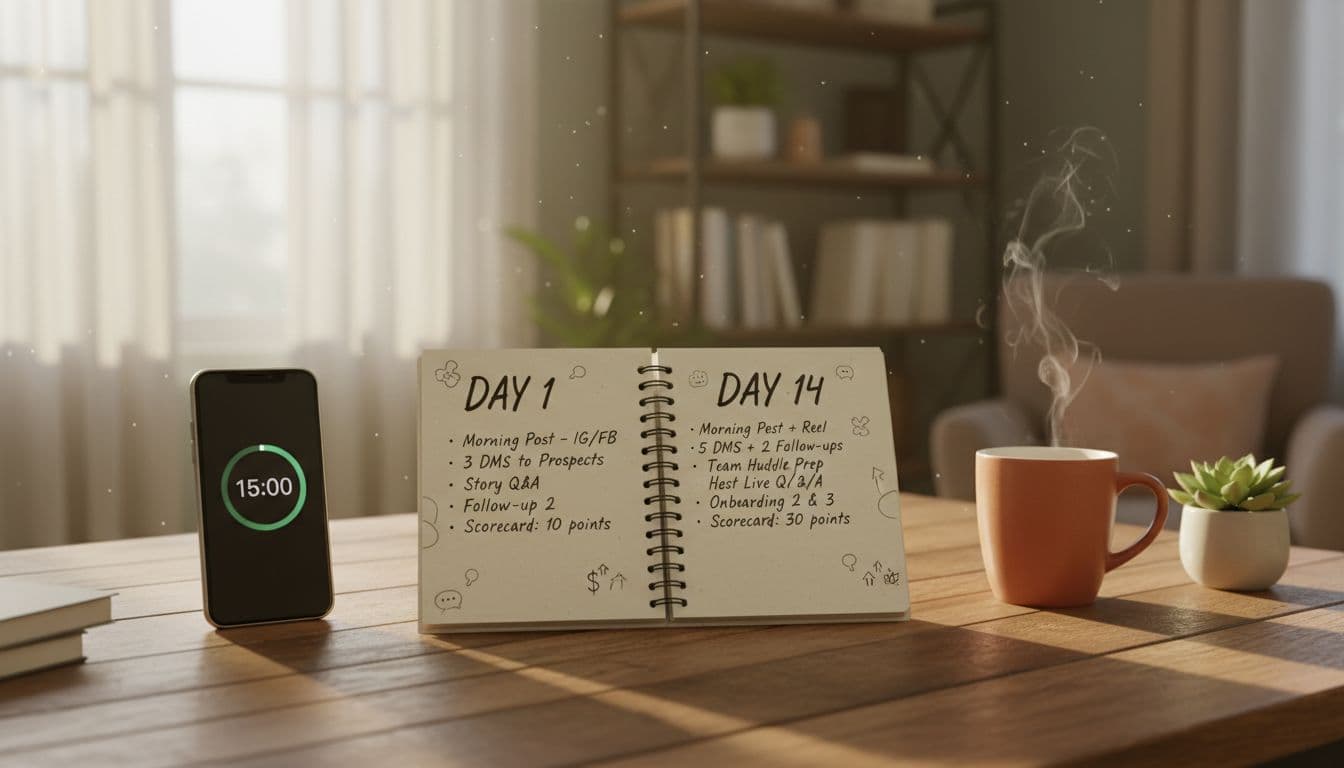
Example Day 1: Zero Leads, Zero Confidence (Start Here)
This day is for when you have no leads, no momentum, and you feel awkward posting. Your only job is to create a small signal and start five low-pressure conversations. Think of it like starting a campfire, you’re not trying to cook dinner yet, you’re just getting the first spark.
Micro-goal (pick one): Get 1 reply today. That’s it.
Post topic (keep it simple):
Share your “why” in plain words, no pitch. Example angle: “I’m testing a 15-minute routine for a side hustle because I don’t have time for 2-hour ‘grind’ plans.” End with a soft call to action like: “If you want my 7-day trial checklist, message me ‘plan.’”
5 DM targets (who you message today):
Choose people who already gave you a small signal so you’re not cold-messaging strangers.
- A recent follower (last 7 days)
- Someone who liked your last post
- Someone who viewed your story (if you can see it)
- A friend who often supports your posts (safe and friendly)
- Someone you’ve chatted with before (even months ago)
DM script (one line):
“Hey [Name], quick question, are you open to a simple 7-day trial plan for extra income if it only takes 15 minutes a day?”
If they say yes, ask how they want it (video overview or written steps). Keep it normal, like texting a friend.
What to log in your scorecard (60 seconds):
- Posted (Y/N)
- DMs sent:
5 - Replies received:
__ - Leads captured:
__ - Overview views:
__ - Note: “What felt easiest today?” (one sentence)
Your win today is doing the reps, not sounding perfect.
Example Day 7: Some Conversations, No Signups Yet
This is where most beginners quit, right before things start clicking. You have a few conversations going, but nobody has joined. Your focus shifts from starting chats to clean follow-up. Follow-up is where the money is, but it needs to feel respectful.
Micro-goal: Move 3 conversations to a clear next step (watch, reply, or opt in).
Follow-up focus (15 minutes total):
- First: reply to any inbound messages (don’t ignore warm people).
- Next: follow up with 3 people who said “maybe,” “busy,” or “send info.”
One next-step message (copy this):
“Hey [Name], quick check-in. Do you want the short overview, or should I just send the 3-step trial checklist?”
It gives them control and keeps you out of “convince mode.”
Handling “send info” requests (permission-first language):
When someone says “send info,” don’t drop a random link and hope. Confirm what they want, then send the right thing.
Use this:
- “Sure, happy to. Are you asking about the 7-day trial steps or the bigger picture overview?”
- “Also, are you okay if I follow up tomorrow to see what you thought?”
That last line matters. It sets consent and keeps you compliant. It also matches what permission-based marketing is supposed to be: they raised their hand, you deliver what they asked for, and you respect their choice if they pass.
What to log in your scorecard:
- Follow-ups sent:
3 - “Send info” requests:
__ - Overviews sent:
__ - Overviews watched (confirmed):
__ - Next follow-up date for each (Day 9, Day 10, etc.)
No signups yet doesn’t mean nothing is working. It usually means your follow-up cadence is still warming up.
Example Day 14: First Signup (or Close Call) + Onboarding Sequence
If you get your first signup, your job changes fast. You’re not “selling” anymore, you’re retaining. A new person who takes small action in the first 24 hours is far more likely to stick. If it’s a close call (they watched and asked questions), this same sequence still works.
Micro-goal: Get them to complete Step 1 today (one small win).
Welcome + 3-step onboarding message sequence (copy and edit):
Message 1 (welcome, sent immediately):
“Welcome, [Name]. You made a smart move starting with a 7-day trial. Keep it simple, we’re doing small steps daily so it doesn’t get overwhelming.”
Message 2 (the 3 steps, sent right after):
“Here are your first 3 steps today:
- Confirm your login is working
- Watch the short overview (I’ll send it next)
- Reply ‘DONE’ when you finish so I can give you your 15-minute Day 1 routine”
Message 3 (set expectations, sent later the same day):
“Quick expectation so you feel good about this: results vary, there’s no guarantee. What we can guarantee is a simple daily method. If you do 15 minutes a day for 7 days, you’ll build skills and momentum fast.”
Next actions for the new member (keep it beginner-safe):
- Pick a daily time (same time each day if possible)
- Post one simple piece of content (you can give them a template)
- Send 3 permission-based messages (not 30)
- Track the scorecard numbers for the week (posted, DMs, replies, leads, overviews)
How to keep them consistent with a 15-minute DMO:
Tell them the goal is not to “learn everything” in week 1. The goal is to show up daily.
A simple rule that works: same time, same order, same timer. If they miss a day, they don’t double up. They restart the next day with one post, three messages, and logging. That keeps their confidence intact, which is what drives consistency.
Where AI and Automation Help (and Where They Don’t) in 2026
In 2026, AI can make your 15-minute routine feel like a real system, not a random hustle. The key is using it like a helpful assistant, not like a mask you hide behind. AI is great at repeatable work, organizing details, and giving you a clean first draft. It’s weak at trust, timing, and real human judgment.
Think of it like power tools. They help you build faster, but you still have to measure, choose the right materials, and make sure the finished thing is safe.

Good Uses of AI in a 15-Minute Plan
If your routine is only 15 minutes, AI should do the parts that steal time, not the parts that build relationships. The best use is when AI helps you respond faster and stay consistent without sounding like a robot.
Here are the “good uses” that fit a beginner routine:
- Drafts, rewrites, and hooks: Use AI to create 3 to 5 hook options for a post, or to rewrite your messy idea into something clean. Then you choose one and edit it into your voice. This keeps you posting daily without spending half your evening thinking.
- Human-sounding reply suggestions: AI can suggest short DM replies for the same common questions (“Is this MLM?”, “How much time?”, “How do I start?”). You still review every message before it goes out.
- Reminders and organization: This is where automation shines. It can help you remember who asked for info, who watched an overview, and who needs a polite follow-up on Day 3 or Day 7. That makes your follow-up more steady, and it reduces the “I lost that person in my inbox” problem.
The most important rule: always add personal context. One sentence is enough. Mention where they came from (“I saw you liked the 15-minute routine post”), what they said, or what your own experience was. Without that, AI-written content starts to feel generic, and generic content gets ignored.
If you want a simple way to keep your content consistent without sounding copy-pasted, use a basic posting structure like the one in Network Marketing Content That Converts, A Simple Posting Ratio (Value, Proof, Offer) You Can Use Weekly.
Bad Uses That Damage Trust (Avoid These)
AI can save time, but it can also burn your reputation fast. In 2026, platforms are stricter about spam behavior, and people are more sensitive to anything that feels fake or pushy.
Avoid these trust-killers:
- Mass messaging without consent: Automation is not permission. If someone didn’t ask for info or interact with you, blasting them is a fast way to get reported, blocked, or restricted. It also trains you into “volume thinking” instead of real conversations.
- Pretending AI is a person: Don’t act like a bot is you typing live, and don’t let an AI voice or assistant “play human.” If you use AI support, be straightforward. Trust grows when you’re honest.
- Exaggerating results: AI makes it easy to write hype. That’s a problem. Big claims about income, fast results, or “automatic team growth” can cross compliance lines and turn people off. This also creates FTC risk when income claims are not typical or documented.
- Ignoring opt-outs: If someone says “stop,” “remove me,” or “not interested,” the conversation is over. No debating. No extra follow-up. Respecting opt-outs protects your account and your name.
- Using scraped or bought data: Building lists from scraped emails, random DMs, or questionable lead sources is asking for trouble. Privacy rules and email platform policies are tighter, and bad lists can get you blacklisted.
A simple gut-check before you send anything: Would you feel respected if this message hit your phone? If the answer is no, rewrite it. This is how you grow long-term, especially when your goal is a steady side hustle, not a short-term spike.
Quick Recap: AI Viral Downline vs. GDI Smart Rotator (Factual Fit)
These two tools solve different problems, and knowing the difference helps you choose the right “support” for your 7-day trial routine.

AI Viral Downline is best understood as communication support. It can help with messaging workflows, follow-up organization, and reply drafting. Some systems also track activity like calls, logs, and basic performance reporting, which can help you stay consistent. The catch is simple: you must run it in a compliant way. That means permission-based messaging, honest wording, and clean opt-outs.
GDI Smart Rotator is best understood as structure and placement support. Instead of putting all pressure on you to personally recruit everyone, a rotator approach can help distribute placements inside the team system. For beginners, that can reduce the “chase everyone you know” feeling and give you a cleaner starting lane. If you want the bigger picture on the rotator model, read the GDI Rotator residual income guide.
One expectation to keep clear for both: there are no guarantees. Automation can help you move faster and stay organized, but it can’t replace effort, consistency, and real conversations. Your 15-minute routine still works the same way: post, follow up, track signals, and improve week to week.
FAQs
If you’re new to MLM and trying to grow a team on a 15-minute daily routine, you’re going to have the same questions almost everyone has. That’s a good sign. It means you’re thinking like a real business owner, not chasing hype.
This FAQ list is built around the exact friction points that show up during a 7-day free trial plan: what to do daily, how to use AI without sounding fake, how to follow up without being pushy, and how automation fits (including rotator-style team building). If you want a bigger picture on the “automated team growth” concept, this guide helps: Build residual income with GDI Rotator.

FAQ List (No Answers)
Use these as quick reference questions (and as ideas for daily posts, Reels, or short videos). If you can answer these clearly, you’ll sound confident without sounding salesy.
- What is the best 15-minute daily routine for MLM beginners?
- Can AI help me Team Build without cold messaging?
- How many DMs should I send per day in a Side Hustle plan?
- What should I post daily to Make Money Online without sounding spammy?
- How do I follow up without annoying people?
- Is Automation allowed in MLM marketing and what rules matter most?
- What is a rotator and how does the GDI Smart Rotator work?
- What is AI Viral Downline used for in daily prospecting?
- How long should I run a daily routine before changing it?
- What metrics matter most for MLM team growth?
- How do I build trust when people ask about MLM?
- What if my friends and family don’t want to join my Home Base Business?
Conclusion
This beginner plan works because it keeps you focused on consistency, not hype, and it respects your time. A 15-minute routine can grow an MLM team when you treat it like a daily habit: you post to create signals, you follow up with permission, and you track simple numbers so you can improve without guessing. Tools and automation can help with drafts and organization, but trust still comes from clear, honest conversations and clean follow-up.
Here’s the daily recap to keep it simple:
- Micro-goal (1 outcome only)
- Post (1 piece of content)
- Conversations (reply to inbound, then a small batch of permission-based DMs)
- Log/queue (scorecard, then set tomorrow’s first action)
Commit to 14 days before you judge it. Do a quick weekly review (what got replies, what got opt-ins, what to repeat), then keep your messaging permission-based, truthful, and compliant.
Your next step is Day 1, open your Notes app, start the scorecard, set a 15-minute timer, and run the routine daily for the next 14 days (7-day free trial included).
